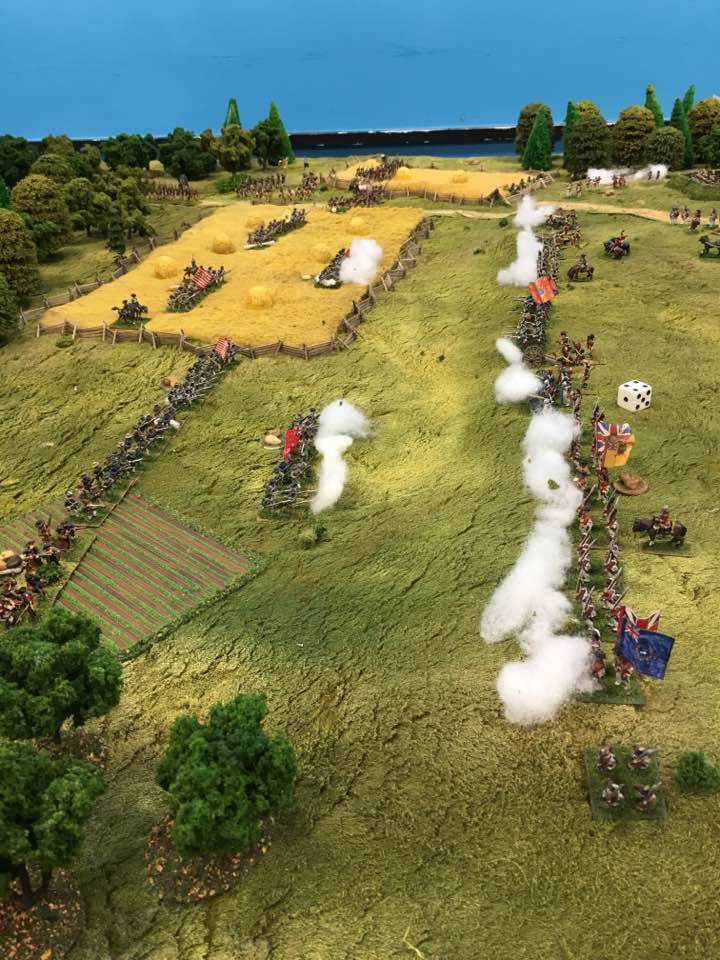
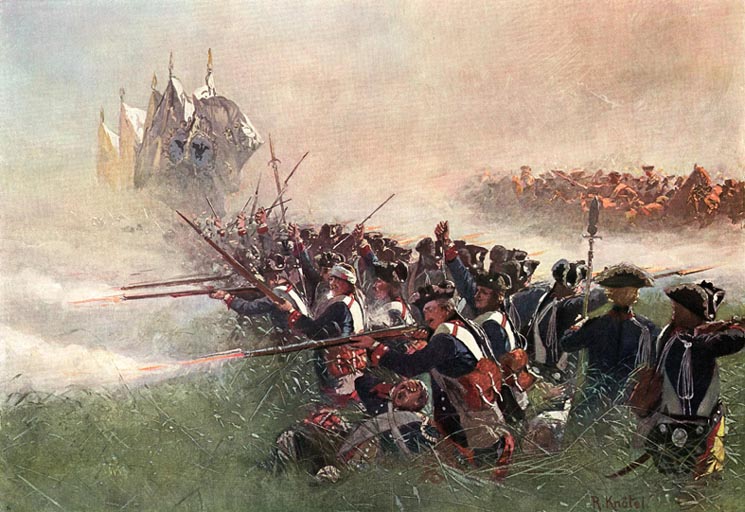
Background image is Les Dernières Cartouches (The Last Cartridges) by Alphonse de Neuville
Showing posts with label gaming groups. Show all posts

Wednesday, November 9, 2016

catching up: early Autumn 2016

While I haven't posted recently, I've not been neglecting my wargaming entirely. :-)

Black Powder AWI at Army of Central Maryland
I recently ran a Revolutionary War game at the local club using the Black Powder ruleset; I'll soon have a post about that and some related games I'm planning.


A few weeks before that, I also ran a Rev War Black Powder game at a friend's house, mostly as a trial and to gain familiarity with the rules.
Black Powder AWI at Peter's

Before that, I've played a good deal of Advanced Squad Leader (three games in a month, which is kind of a record for me),

ASL with Gorkowski
ASL with Fortenberry

ASL with Frum
 played Red Poppies: Ypres Campaign with the designer,

Gorkowski explains my cruel but inevitable defeat.
 played Star Wars: Armada with my best friend while his teenaged son refereed (with lots of heavy sighs at our adult ineptitude),

Star Wars:Armada with Peter
played a British Grenadier scenario of Frayser's Farm,
Burgoyne's British let loose a volley.
and refought the battle of Vendôme with Bruce Weigle's excellent 1871 rules at the author's house.

Another of Bruce's incredible battlefields.
I also took a day off work last week and had a full weekend at Fall In. I played four different games: two Carnage & Glory games set in the Polish Commonwealth (17th century),

My Russian nobles about to kick Polish husaria ass!
one medieval game with Bob Bryant's new small-battle Clans and Companies rules, and a final Carnage & Glory game set in the American Revolution. I had several other games on my list to try to get into, but none of them panned out, alas. I also did a bit of shopping for an upcoming project.

I'll try to arrange for a few posts to summarize these exploits and get a few more photos up. Needless to say, I've also been continuing to read and learn about the 1777 Philadelphia campaign and to enlarge my Rev War research library.

I've also expanded my board wargame library a bit and taken up two new sports, curling and German longsword fencing. So, it's not like I've been sitting on my duff. :-)

Thursday, December 10, 2015

La Grande Guerre: Testing a New Game

Prussian Leibgarde in action.
R.J. "Rocky" Rockefeller is a prolific wargame author. Among his many titles are Fortunes of War, Champs des Batailles, Bushi, Virtues in the Fields, Blows Must Decide, and his latest project, La Grande Guerre, rules for battles of the Seven Years War. Last weekend, I and two other members of the Army of Central Maryland game club got to help him playtest this new game.

La Grande Guerre depicts battles at a fairly high level of abstraction for a miniatures wargame. Units, consisting of large single stands of many figures, represent brigades of infantry (4-6 battalions) or cavalry (8-12 squadrons) or batteries of a dozen or so guns. Each is rated for strength/training, morale/ferocity (infantry and artillery also get firepower), and movement, with some infantry units getting an extra bonus for including skirmish troops and/or grenadiers.

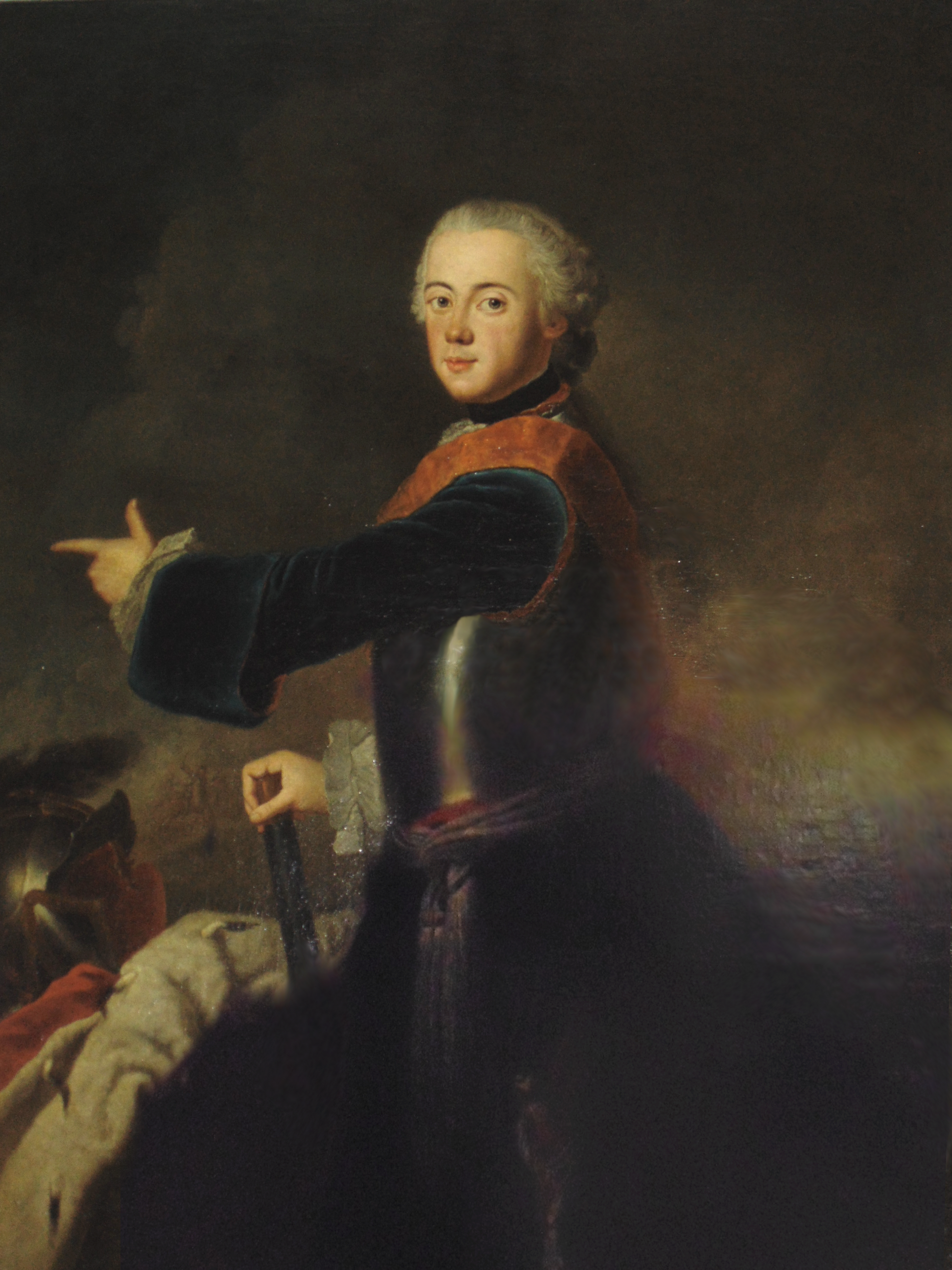
Prinz Heinrich, the Prussian commander
Brigades operate in divisional groups, each of which has a commander with greater or lesser ability to inspire the men in combat and to keep them organized and moving towards their objectives. A small number of brigades may also have an especially inspiring leader who conveys an extra bonus in combat. Superior to all the divisional officers is each army's commander in chief, whose ability rating can help his side gain initiative each turn and who can issue new orders to the divisional commanders, superseding the directions that they start the game with and redirecting the efforts of their commands.

In each turn, players determine which army will have the initiative and what previously dispatched orders have been received and understood. Then the side with the initiative moves, fires, and executes combat;  the opposing side follows suit. Because the scale of the game is so great, only artillery gets long-range fire; infantry fire and any cavalry skirmishing is abstracted into the overall combat system. Units can become "nonplussed" (disordered, shaken, or disrupted) from artillery fire, from combat, or from having friendly units retreat through them or break and rout nearby. Only by stopping to reorganize under the direct guidance of a general can a unit recover from being nonplussed.

Charles, le Prince de Soubise
In Sunday's scenario, a Prussian army under Prinz Heinrich von Preussen attacked a French army commanded by Charles, the Prince of Soubise near the Hesse-Darmstadt town of Kempfeld* in 1758. The Prussians and French were both attempting a show of force, so each army was focused on defeating the enemy decisively while preserving their own force and maintaining their lines of communication.

The Prussians had a smaller but much more effective army, with an outstanding commanding general, three outstanding divisional generals, and four outstanding brigade commanders. There were three divisions of infantry and two of cavalry, with significant numbers of accompanying artillery. The French had a larger force but a much less impressive one, with no outstanding officers, no grenadiers or tirailleurs, and one division of good infantry among five and one division of good cavalry among three.

The French sought to envelop the Prussians, attacking both on their right with their best cavalry and on their left with a mixed force of horse and foot that sought to march around the flank of the Prussian army, somewhat impeded by woods and streams. The Prussians, in turn, determined to attack directly and with as much vigour as possible, so as to fight a portion of the French army with most of their own, while leaving only a thin screen of light horse to delay the French flanking move.

This choice largely paid off for the blue-coats, as their cuirassiers (and even their dragoons) made short work of most of the French regiment de cheval. Even the French guard cavalry received rough handling from the North Germans, especially the brigade that included the Prussian Garde du Corps, commanded by an able brigadier and urged on by a divisional commander who was Seydlitz or his equal. The French had held their foot guards in reserve, but now these were moved to reinforce the infantry of their right wing who were being pummeled by their opposing Prussian infantry and could clearly soon expect to feel the weight of the Prussian horse as well.

Rossbach, a battle that the Prince de Soubise would like to forget

One brigade of French guard cavalry finally realised the black disgrace that was overcoming the whole body and won a series of combats against Prussian horse, putting several heavily worn brigades to flight before being repulsed themselves. The foot guards had driven strongly into the left wing of the Prussian infantry, and the French left wing was finally bringing itself to bear on the Prussian right and rear. We had both done considerable damage to each other's armies, but neither army was ready to break yet when the game ended.

 Rocky has already made some revisions to the rules based on our first game, and I'm looking forward to our next go at them.

I do hope to have somephotos up soon, both of this game and of the previous weekend's BCW game.


*Rocky actually specified the generic town of Kampffeld, or "battlefield", but I found to my amusement that there actually is a town of Kempfeld in the Landgraviate of Hesse-Darmstadt in the 1750s, now part of Rhineland-Palatinate.

DC Area Gaming Opportunities Upcoming

I decided a few weeks ago to post all notices of upcoming wargaming events here instead of advertising by email. It turns out the next will be sooner than I anticipated. This Sunday a couple of us are getting together in Wheaton for some board wargaming. Comment here or drop me a line and I can give you the details.

Likewise, my friend Mr Invisible and I are still planning a weeknight gaming session next Thursday. Same provisions apply.

At the same time, there are a couple of local gaming groups and shops that are worth checking out:

The Army of Central Maryland has a Yahoo group and a Facebook page.They can be found at the friendly and well-stocked Games and Stuff in Glen Burnie on most Sundays.

The Riverdale Gaming Conclave and the Non-Traditional Board Games groups can be found on Meet-up and on the Maryland side of DC.

The Washington Area DBA Gamers (WADBAG) and the DC Conscripts ASL group are still around but pretty quiet these days.

It's been a while since I talked to them, but the far side of the Potomac has the Northern Virginia Gamers (NOVAG), the Dulles Area Historical Gamers (DAHGS) and some other groups that hang out at the excellent Huzzah Hobbies in Ashburn.

And no local list would be comeplete without mentioning DC Game Night and the Games Club of Maryland or DC's own Labyrinth game store and College Parks's Board and Brew.

Monday, December 7, 2015

The Battle of Montgomery (again...)

A portion of a 17th century map of Montgomery
I recently had occasion to run a Carnage & Glory game at Games and Stuff in Glen Burnie for the Army of Central Maryland (AOCM).

I had originally thought to continue the British Civil War (BCW) adventures of Sir William Brereton by putting on a recreation of the Battle of Hopton Heath (also discussed briefly here), but I had second thoughts. Hopton Heath is not one of the larger battles of the war (less than 3,000 combatants total), and I was afraid that I might end up with more players than commands, so I moved to a slightly larger action. I picked the 1644 Battle of Montgomery, which was much larger (over 5,000 combatants). 


Alas, I chose Montgomery without knowing that not just one but two other GMs had portrayed this battle at AOCM in recent years.

Montgomery is in some ways a challenging action to make a fun game out of. For wargamers, fun battles are those where both sides feel as if they have a good chance to win. This may come from both armies having roughly comparable numbers of troops; or if the armies are unequal in numbers, the smaller side has better training or morale, or a terrain advantage, or better weapons and equipment. At Montgomery, the main difference seemed to be that the smaller side (Parliament) had some stellar leaders (Sir John Meldrum, an experienced professional Scots military officer, and my buddy Sir William Brereton, an experienced officer who had held Cheshire for Parliament) who managed to rally their force when things looked black and turn a defeat into a resounding victory.

I hoped to give Parliament the chance of creating this same event by giving their commanders, especially their CinC, Meldrum, and their infantry commander, Sir William Fairfax, top ratings. Sir William Brereton and  Maj Gen Lothian also got highly rated. The Royalists under Sir John Byron got good officers, but not outstanding ones.


Sir John Meldrum

On the day, after some tiresome delays with getting things printed, I got to the shop and started getting set up. I briefed the Royalist players, then watched them set up while the Parliamentarian players did some shopping, then the Royalists stepped away while I briefed their opponents and they set up.

Mission

The Parliamentary forces that had been gathered to relieve the Royalist siege of Montgomery Castle consisted of about 2,000 foot, men of Yorkshire and Cheshire, along with 1,500 horse under Sir Thomas Myddleton, men from Denbigh and Cheshire. Their intent had been to chase off the Royalist army and to restore the town and castle of Montgomery to Parliament. But the Royalists had also assembled a large force (2,800 foot, 300 dragoons, 1,400 horse), considerably outnumbering Parliament's troops. So while their goal remained to defeat the enemy, Parliament's back-up plan was to fall back across the river Camladd and towards Welshpool. In order to do so, they would need to hold Salt Bridge, the one crossing point accessible to their army.

The Royalists, rather more simply, needed to attack and disperse the enemy force. Historically, Sir John Byron took the opportunity of attacking on the day that a large body of enemy horse had been sent out to forage, thus accentuating his advantage in numbers.

Troops

The Royalists deployed first, along a ridge overlooking the Camladd river, with a road (I think what is now the B4388 Welshpool-Montgomery road) running perpendicular to their front along their left flank, towards Salt Bridge.

They arrayed their infantry to the left--with dismounted dragoons screening the flank and heading towards some rough country, perfect terrain for them--and their horse on their right, massed to make a single strike force.
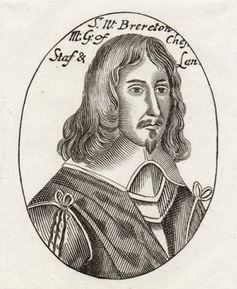
Sir William Brereton
The Parliamentary players decided on a more traditional formation: infantry in the center, with horse on both flanks. They had another force of mounted troops off-board, the foragers under Sir William Brereton, due to return shortly after the beginning of the battle.

Terrain

West of the road and south of the river there was an area of bad ground--shrubberies, swamps, and broken terrain--which the Royalist dragoons hoped to make their own. East of the ridge along which the Royalists deployed there was an area of many small hills, but the battle never reached that area. Most of the combat took place up and down a rolling hillside, not terribly steep, and quite open. Looking at satellite imagery of the area on Google Maps and assuming that at the time it was not as enclosed as similar land might be in central England, this looks like perfect cavalry terrain.

Execution

In our battle, Sir John Meldrum and Parliament had the initiative at the outset, and they lost no time in attacking on their left with two units of horse. On the right, one unit of horse surged forward, hoping to overthrow the Royalist dragoons, which were dismounted and holding a line along the Royalist flank. In the center, the Parliament's foot held its ground.

The attacks on both flanks went poorly. The horse vs. horse action on the eastern flank was very evenly matched, but Parliament lost both of the initial encounters. On the west, the dragoons levelled and gave a devastating opening volley, putting the brakes on the enemy's cavalry charge. Parliament's cavalry on this side of the battle remained in a confused and disordered state, unable to advance and unwilling to go backwards. Once the foragers arrived, these horse had just decided to retire and turned the tricky operation of deploying a force in march column across a defile into an unfortunate traffic jam.

On the east, several squadrons of Royalist horse pursued their defeated foes far into the rear of the Parliamentary lines. More engagements went much the way of the first, with the one Parly horse unit that defeated an enemy troop quickly hit by another Royalist cavalry unit and forced to retire.

The Parliamentary foragers did return quite speedily and might have turned the tide against the King's men. Unfortunately, I had misread the historical course of events and had them enter from Parliament's rear area rather than from their left flank. As a result, the horse were held up for some time crossing over Salt Bridge and trying to deploy while the rest of Parliament's forces were being pushed back towards them.

In the center, the Royalists had taken the initiative in the foot battle, with their more numerous pike and shot pressing the Parliamentary center so hard that they took to flight. True to history, these footmen fell back toward the river and then (most of them) rallied and faced the enemy again. As in 1644, the men of Cheshire refused to be defeated.

By that point, however, the Parliamentary commanders had failed their personal morale checks and conceded the battle.

Aftermath

I think the scenario is still a viable one, but I think it needs some retouching. For one thing, the Parliament's foragers need to come on in the right place! Having three additional units of horse on the flank where the cavalry battle is taking place would make the chances that Parliament could historically defeat the Royalist horse much higher.

For another thing, deployment should probably be set, not free form. Our Parliament players split their horse between two wings, even after seeing the Royalist deployment with all its horse on one wing, and one of those Parliament wings accomplished essentially nothing in the ensuing battle, as it was left unused after its initial repulse by the Royalist dragoons.

Both sides should have a slightly higher number of officers; this is a judgement call, as there is nothing comparable to the historical unit structure to say how many officers should be represented in a C&G order of battle. But given the importance of officers in the combat and morale system of C&G, the scenario should probably represent all the major officers, not just most of them.

Finally, while chance delivered something like the remarkable rally of the Cheshire foot that took place historically, it would behoove the moderator to award the Parliament player a few "resets" of troop morale for their foot to represent what took place at the original battle. This would allow the OB to keep most of them as trained, rather than veteran troops, while giving them a chance to repeat the dogged determination of their historical forebears.

Photos

I do have some photos to add, but I didn't want to wait to post this any longer. I'll have a follow-up post with photos. 

Other References

Wikipedia article on the relief of Montgomery Castle

Cromwell Association page on Montgomery

Photos of a Montgomery game using a different set of rules

Wednesday, November 25, 2015

Trying Something New

My friend Eric and I have often bewailed the fact that we find it so difficult to get together with friends for a wargame. Schedules are full, life is busy, and coordinating a group of wargamers is like herding cats (which I've done, but it takes effort!) One starts out with a long list of prospective participants, tries to find dates that will work well for the largest number, then all those unanticipated things hit (partners and family making other plans, cars breaking down, jobs calling in everyone on the weekend).

So we decided to try an experiment. First off, we're going to coordinate more with other existing local groups. It turns out that every different social media platform (Yahoo, Facebook, Googlegroups, Meetup, Boardgamegeek) has its own set of cadres, and none of them talk much with each other (or even know about each other).

Second, we're going to try meeting up once a month on a week*night* (in addition to any sort of weekend games we play). While weekend days provide more time for play, they are also frequently in great demand by family and other hobbies. Weeknights offer less time, so the scope of games has to be smaller, but that smaller timeframe also means that they're less likely to fill up with other committments.

And, third, we're going to stop aiming for the stars. Usually when we try to organize events, we're hoping for half a dozen players or more and wind up disappointed when we're only able to collect two or three (including us!) For these events, we're going to plan on just the two of us and be pleasantly surprised if more folks show up. We've both got large enough game libraries that we could play for years and never exhaust our two-player titles, but if third, fourth, and fifth players show up, we'll still have plenty of options, either for one large game or several smaller ones.

So the first date we're aiming for is Thursday, December 17th. We're looking to play GMT Games' Rebel Raiders in the High Seas, a highly rated strategic/operational game about the maritime and riverine warfare during the American Civil War. If we get more players, we may simply add another game, or we may change over to something multiplayer.

We haven't picked a location yet, but if you post a comment here to indicate you're interested, I'll be sure to get back to you with information.

I'll post an AAR afterwards, and if we continue our experiment, I'll post here so that folks can contact us if they're interested in joining in.