Background image is Les Dernières Cartouches (The Last Cartridges) by Alphonse de Neuville
Showing posts with label ASL. Show all posts

Wednesday, November 9, 2016

catching up: early Autumn 2016

While I haven't posted recently, I've not been neglecting my wargaming entirely. :-)

Black Powder AWI at Army of Central Maryland
I recently ran a Revolutionary War game at the local club using the Black Powder ruleset; I'll soon have a post about that and some related games I'm planning.


A few weeks before that, I also ran a Rev War Black Powder game at a friend's house, mostly as a trial and to gain familiarity with the rules.
Black Powder AWI at Peter's

Before that, I've played a good deal of Advanced Squad Leader (three games in a month, which is kind of a record for me),

ASL with Gorkowski
ASL with Fortenberry

ASL with Frum
 played Red Poppies: Ypres Campaign with the designer,

Gorkowski explains my cruel but inevitable defeat.
 played Star Wars: Armada with my best friend while his teenaged son refereed (with lots of heavy sighs at our adult ineptitude),

Star Wars:Armada with Peter
played a British Grenadier scenario of Frayser's Farm,
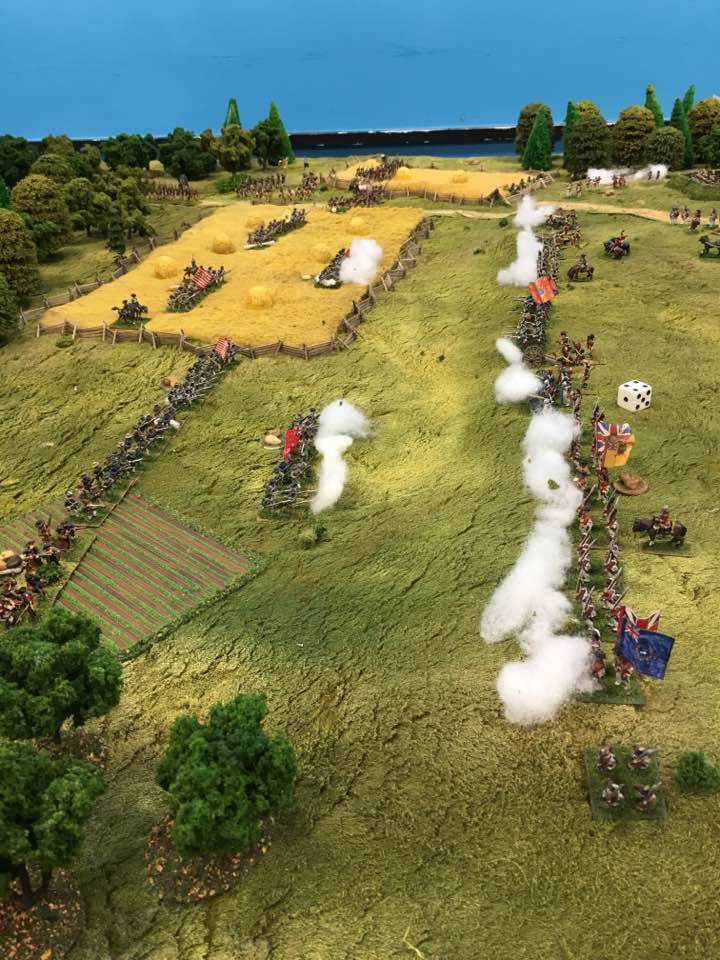
Burgoyne's British let loose a volley.
and refought the battle of Vendôme with Bruce Weigle's excellent 1871 rules at the author's house.

Another of Bruce's incredible battlefields.
I also took a day off work last week and had a full weekend at Fall In. I played four different games: two Carnage & Glory games set in the Polish Commonwealth (17th century),

My Russian nobles about to kick Polish husaria ass!
one medieval game with Bob Bryant's new small-battle Clans and Companies rules, and a final Carnage & Glory game set in the American Revolution. I had several other games on my list to try to get into, but none of them panned out, alas. I also did a bit of shopping for an upcoming project.

I'll try to arrange for a few posts to summarize these exploits and get a few more photos up. Needless to say, I've also been continuing to read and learn about the 1777 Philadelphia campaign and to enlarge my Rev War research library.

I've also expanded my board wargame library a bit and taken up two new sports, curling and German longsword fencing. So, it's not like I've been sitting on my duff. :-)

Monday, August 29, 2016

Catching Up: Late Summer 2016

Sur Dynasty forces sweep towards the Mughal army. (Author)
Nearly two months later and while the summer feels like it's dragged on forever, the end is in sight!

I was able to got to Historicon this year for the first time in forever. I had a blast, playing a Carnage & Glory scenario of the battle of Camden run by David Bonk and Bob McCaskill, an Et Sans Resultat scenario of the battle of Vitebsk run by the author, David Ensteness, and a Pike & Shotte game (Providence at Panipat, a battle in 16th century India) run by John Shirey.

Punic War battle in Triumph! WAR. (Author)
I also played in two mini-tournaments of Triumph! WAR, the new ancient/medieval wargame from the Washington Grand Company. One campaign was set in the First Crusade, the other in the Punic Wars.

I did a good deal of shopping, met up with a few old (and new) friends, and generally had a good time. Now that I know it's not as hard to get to or as difficult to navigate as I thought, I will be back more often.

I've made it to two more game days with the DC Conscripts, the local ASL club. In one I got in a couple of scenarios from the late Ian Daglish's Scotland the Brave scenario pack (StB8 The Lost Platoon, StB3 Seaforth Objective, and StB2 Cameronian Crossing). At the other, Stephen Frum gently and politely hammered me into the ground as we played BoF4 About his Shadowy Sides.

Americans (left) advance toward the British (right). (Author)
And I did get a little Rev War miniature gaming in; Mr Invisible and I made it up to Games and Stuff in Glen Burnie to meet some of the local Marines (British Rev War, not modern USMC :-) for a playing of the battle of Bemis Heights with British Grenadier. Mr I. faced off more or less opposite me, he commanding the American right and center and me the British center and left. I bloodied the nose of one of his militia brigades as it thrust forward, but we Brits had to give up a great deal of the ground to find a position safe enough to defend, and I'm not sure we would have been able to hold on, as the American left was setting up to give us a walloping blow on our weak right side.

In other Rev War news, I've been reading away and taking copious notes, and I hope to have another couple of posts on Project 1777 available shortly. One of the surprises at Historicon for me was picking up the range of Rick Priestley's new games (Black Powder, Pike & Shotte, and Hail Caesar) after, I admit, poo-pooing them for some time. They're not the most simulation-y or period-tailored sets of rules in the world, but they are fairly easy to learn and provide both a simple framework and enough widgets to hang on it that I'm impressed by what I have seen of the period supplements. I enjoyed the one P&S game that I played, and I look forward to trying out several more scenarios with these rule sets. I think their breadth of scope and shallow learning curve will make them popular among my friends who like military history and enjoy playing games but who are not rules junkies or interested in/prepared to learn more complex games with many more moving parts and details to keep track of and consider.

Friday, July 8, 2016

Catching Up: Early Summer 2016

While work has been busy, keeping me from doing as much blogging as I would like to do, I have also had the opportunity over the last couple of months to squeeze in a bit of wargaming here and there.

For one thing, I was able for once to get out to a meeting of our local ASL club, the DC Conscripts. I played two scenarios, WO3--Counterattack at Carentan and the venerable scenario 11--Defiance on Hill 30. I lost both, the first to Jason Sadler and the second to David Garvin, but enjoyed both games.

My Germans in their futile attack on Garvin's paratroopers.
Second, I met up with a group of gamers in Falls Church who meet somewhat regularly to play board wargames. I've now played four sessions with them. In one I finally got to play GMT's Virgin Queen, an excellent but highly complex game of European great-power politics in the 16th century. As the Ottoman Empire, I was able to rid the Mediterranean Sea of the Spanish scourge and establish my rule over almost all of the North African coast, as well as roust the Knights of Malta from their island stronghold. I came in third out of six blocs, which against some brainy opponents made me feel good.

Having thrashed the Spanish, the Ottoman navy book in for a minibreak at the Knights of Malta B&B.
In two other outings with the group I've had a chance to play GMT's new COIN game, Falling Sky, about the politics and warfare among the Romans and the Gallic states of the 1st century BCE. In the first playing I drew the Arverni, the central Gallic faction, against the two game designers, one playing the Romans and the other their Aedui allies. with a fourth player in charge of the Belgi, the warlike northern Gauls. I acquitted myself adequately there, with a drawn game when we stopped. On the next occasion I got the Belgi and was able to come close to winning when we had to stop the game for lack of time.

Our German cousins (black) regroup, but the Belgi (gold) have reclaimed all their territory.
And most recently I brought Wellington and was randomly selected to command the Iron Duke. I completed the siege of Ciudad Rodrigo in record time, recaptured Salamanca, and was able to draw Marshal Soult off from his siege of Cadiz, but he and Wellington fought to a standstill and we had to call the game before any decisive result was achieved.

My canny French opponents Adrian (Joseph, left) and Roberto (Soult, right) plot and plan.
 UPDATE: Here's a blog post by our host on recent boardgaming.

I've also managed to get in a couple of miniatures game. A couple of weeks ago several of us played two American Revolution scenarios using the new edition of Sharp Practice from the Too Fat Lardies. I'll put up some photos and comments in a future post, but my short review is that I was disappointed in the rules. They seem to have gone in just about the opposite direction I was hoping--instead of clarifying and streamlining the first edition rules, they're no clearer and have added layers of complication that (in my opinion) add nothing to the game. Instead of becoming more like a historical wargame covering small-unit actions (a field woefully bare in horse-and-musket era gaming), they've become more generic and game-y.

M&T: Mohawk warriors move forward in an attack on a French outpost.
I also played two scenarios of Muskets & Tomahawks recently. In like manner, I'll try to add a post with photos and commentary from our games soon. The game rules are much more clearly written than Sharp Practice, but I didn't find the games terribly compelling. Units are very small and combat results are therefore highly variable; a single round of shooting from one unit on another can be completely ineffective of completely catastrophic. Like Sharp Practice, the game feels more like watching a Hollywood movie than watching a historical battle unfold.

Wednesday, February 17, 2016

Inter Ludus: Games Between Games

While I and the 1777 elves are gearing up for the Philadelphia campaign, I've been enjoying other game-type activity.

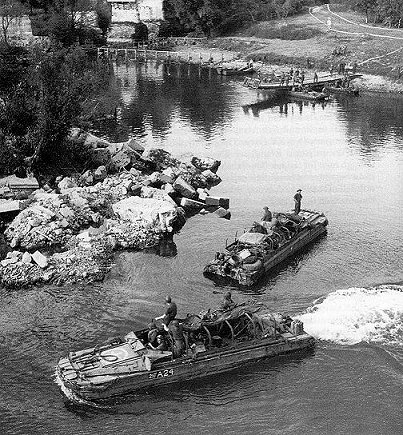
DUKWs at Veronnet (Worcestershire Regt.)
Last weekend I had the pleasure of finally sitting down to a game of ASL (two, as it turned out) with a chap Victory Comics in Falls Church, a location new to me that features a large space (including a good many gaming tables), a huge comics selection, and a nice range of boardgames. We played a scenario from a new module that's being playtested for Bounding Fire Productions, a Historical Advanced Squad Leader (HASL) treatment of Operation Neptune. No, not the D-Day landings, but the 43rd Wessex Division's opposed crossing of the Seine River in August 1944. This scenario features an infantry company attempting to cross the Seine in boats with covering fire from tanks and machine-guns. You'll have to wait for the module for details, but suffice to say this scenario will be a nail-biter with some toys to please all types.
I've been corresponding with for many years. We played at

Liberty or Death (GMT Games)
Tonight I'm hoping to inveigle one of my chums into trying out GMT Games' new American Revolution game Liberty or Death. It's an application of the highly popular COIN (counterinsurgency) game system (devised by designer Volko Ruhnke) to the political-military conflict between Britain and her American colonies. Like most COIN designs, it's a four-player game that can be played solitaire or with fewer than four players either by players controlling two aligned (but competing) factions or by the use of well designed paper-based artificial intelligence players. The third and fourth positions in this conflict are allotted to the Native American nations (as allies of the British) and to France (as an ally of the Americans), both of which have their own agendas and their own victory conditions different to those of their allies. Combine a successful basic system, designer knowledgeable in his topic and skillful at adapting the system to purpose, and gorgeous artwork, and you've got what I anticipate to be an excellent game. I've been reading progress reports on this title for some time, and I'm quite chuffed to be able to finally put it on the table.

1866 (Mediaeval Miscellanea)
And this weekend I'll have the pleasure of helping to playtest a scenario for the highly enjoyable 1866 rules from Bruce Weigle. This will be his full-bore treatment of the crucial battle of Königgrätz (aka Sadowa) from the Austro-Prussian War of 1866. I recently got hold of a copy of Avalanche Games' Battles of 1866: Frontier Battles, which includes several engagements from this war but not the conclusive engagement itself (they keep promising to release it as an add-on, but it seems that time has passed that idea by). But I've played one or two battles from this curious war before using Bruce's rules, and I'm looking forward to the mammoth encounter. The 1866 rulebook has Koniggratz among its scenarios, but done as two different engagements. This will be a huge game covering the entire battle.

Reading up on it, I'm guessing that the Austrian may have a chance to overcome their deficiencies of tactics and technology (better-ranged weapons, but slower-firing ones) as the battle kicks off with the Austrians outnumbering the Prussians. They had better take advantage of the opening, however, as the arrival of the Prussian Second Army under Crown Prince Friedrich (son in law of Britain's Queen Victoria and father of the future "Kaiser Bill", Wilhelm II) will seal the Austrian's fate, as it will complete their encirclement and push the odds strongly in the Prussians' favour. We shall see!

Thursday, December 24, 2015

Christmas Eve: Best Wishes and Battles


The bitter battle of Lund, 1757.
I was idly speculating about what game I might pull out if I had some spare time to do a little solitaire play over the holiday. I had gone a fair way down this road until I realised that, as I'm not taking any time off work for Christmas (other than the Christmas Day I am kindly granted by my employer), and since family will be in town after The Day for a visit, the chances that I'll have any such time are minimal. Still, since I'd thought about it, the brainpower might aw well not go to waste, so I thought a blog post might be in order.

The whole idea had been sparked off by a fellow wargamer asked a group devoted to games from the late, great Simulations Publications Inc. which SPI title on the Battle of the Bulge (a famous Christmas battle) had been their favourite. I started wondering about the different Bulge games that I have, which include GMT's Ardennes '44 and Tigers in the Mist, SPI's Wacht am Rhein, Avalon Hill's Bitter Woods, and the ASL modules Wacht am Rhein (Lone Canuck), Baraque de Fraiture (Front Line Productions), Battle of the Bulge (Time on Target) and Kampfgruppe Peiper I and KGP II (Avalon Hill). I could have sworn I owned 3W's Race to the Meuse, but perhaps I sold that years ago when I foolishly thinned out my collection a bit; it doesn't seem by the ratings to have been that good, so perhaps I'm not missing anything.

But what about other winter battles? There have been plenty, surely. What other titles in my collection would be suitable? (And, given the horrendously unseasonable weather we're having here in the Washington, DC, region, maybe give me a little illusory chill?)

Lund, 1676: The cold radiates off the map.
Of course, go early enough in history, and everyone had enough sense not to go out and fight when it was bloody cold and snowing. I think the battle of Lund between Sweden and Denmark was the first I could find in my collection (in GMT's Nothing To Gain But Glory) that features a frosty battlefield, the engagement taking place over the course of a very long December 4th, 1676. The map itself does a grand job of showing how miserable and cold the men must have been during what was one of Europe's most lethal battles.

Clash of Arms Leuthen: Frederick's Greatest Victory
Spin ahead eighty years, and in the midst of the Seven Years War, one finds the battle of Leuthen, fought in Silesia on 5 December 1757. At one point almost dramatically won by the Prussians' skillful pre-battle maneuvering, Leuthen eventually ground to a deadlock, as the Austrian army refused to accept that it had been defeated. I have two ways of trying out this game, either in COA's Leuthen: Frederick's Greatest Victory (a debateable title, in my opinion) or in GMT's Prussia's Glory, which includes Leuthen with Zorndorff, Torgau, and Rossbach, the latter easily beating out Leuthen for title of Frederick's greatest victory.

Move ahead to the Napoleonic era and there are two snowy battlefields that stand out boldly. One is a confused, messy, filled with glorious exploits, but overall a picture of bloody devastation, not unlike the battle of Lund on a larger scale. This was the battle of Preussisch-Eylau, fought on the 7th and 8th of February 1807. In it, two armies each of about 75,00 men traded hammerblows for two days in snow and freezing cold, each eventually losing as much as a third of their army in killed, wounded, or missing. On one side of the battle, the Russian army under Count von Bennigsen gathered together a huge battery of over 70 artillery guns to smash a French assault on his center, riposted with a massive column of infantry, and broke the center of Napoleon's army. In return, the French emperor called on the flamboyant Gascon cavalry commander Joachim Murat and flung him and a massive cavalry force of 11,000 men into the flank and center of the Russian counterattack, crushing it and scattering its men far and wide. Both French and Russian armies paused, like a boxer battered nearly into insensibility, and then, reinforced (Napoleon by more French under Marshal Michel Ney, von Bennigsen by a corps of Prussians under A.W. von L'Estocq) pounded each other for several more hours, until nearly midnight. When he surveyed the battlefield the next day, Ney said, Quel massacre! Et sans résultat ("What a massacre! And without result").

Napoleon and his Garde Imperiale in LBdP-E
Preussich-Eylau has been covered by several designers and publishers. Probably the grandest is Mattson, Spors, and Wimble's La Bataille de Preussisch-Eylau from Clash of Arm's Games. A chapter in the grand La Bataille system, it covers the battle down to the individual companies and battalions. A massive undertaking, it's detail is unmatched.

Another storied series that has covered the battle is Fréderic Bey's Eylau 1807, part of his Jours de Gloire system published by the French wargaming magazine Vae Victis: no less glorious, but somewhat more manageable than La Bataille.

The third entry in my library for this battle is Avalanche Press's Eagles of the Empire: Preussisch-Eylau. Characterized by an innovative area-movement system, this game can be played in a mere three hours, compared with Bey's four and the optimistic six predicted for La Bataille.

Napoleon at the Berezina
The other great battle in the snow from the Napoleonic period is the even more depressing and awful battle of the Berezina, where a French Grande Armée, limping shredded and starving out of Russia, turned at the last great river obstacle and fought to keep itself from being overwhelmed by the (equally battered and starving ) Russian armies that pursued it. This is depicted by the veteran game designer Rob Markham in his Napoleon at the Berezina. That unusual of beasts, a solitaire wargame, NaB challenges the player to find a way for the French to cross the river to (relative) safety before being mauled to death by three converging Russian armies. Fréderic Bey has also covered the Berezina battle in his JdG series, but I do not have a copy of that title (yet).

Of course, World War One is most famous for its Christmas Truce of 1914. I do not, I regret, have any games that depict the famous football match that took place before Germans and British were ordered back to their lines.

World War Two, besides the Bulge, has two other theatres where winter fighting was endemic. Since I'd like to finish this post and get to Christmas Eve festivities, I'll just quickly list some of the relevant titles from the famous Finnish Winter War and from the grim battles of the Eastern Front.

Finland: The earliest game I recall playing on this theatre was James Goff's excellent Winter War (SPI, 1972). Another great title is David Ritchie's Arctic Storm (GMT, 1992). A modern classic on a smaller scale is Mark Mokszycki's Red Winter: The Soviet Attack at Tolvajärvi, Finland, December 8-12, 1939 (GMT, 2012). And, of course, Advanced Squad Leader is represented by (inter alia) MMP's Hakkaa Paalle! module and Critical Hit's Jatkosota: Finland's Continuation War.

Frosty fighting in the streets of Cholm.
Russia: A quick trip to the Ostfront here for me, as my collection of Russian winter battles consists largely of a great older title, GDW's White Death: Velikiye Luki, the Stalingrad of the North and a newer one, ATO's Wintergewitter, about the attempt to break out of the Stalingrad kessel. ASL is represented here by the package Kampfgruppe Scherer: the Shield of Cholm by the talented team at Le Franc Tireur.

I'll close with one that still has not made it to my table, but that I'm interested to try one day. Into a Bear Trap: the Battle for Grozny 1995 is the brainchild of the prolific designer Perry Moore. This well-rated game from ATO depicts the modern urban combat waged over the capital of Chechnya by the Russian army and the irregular forces of the Chechen resistance.

As a wrap up, this blogpost by someone much more dedicated than I to the topic lists more than a dozen different battles (or battle-like events) that took place on or around Christmas, for your extended Christmas warfare pleasure.

Merry Christmas to everyone who celebrates it, and happy holidays to all!


Thursday, September 11, 2014

Operation Brassard: The French Return to Elba

Goumiers and their mules boarding a landing craft.
While I'm trying to keep a lot of my gaming attention on exploring the Great War in this year of its opening's centennial (as featured in my other blog, The Hissing Fuse), I haven't entirely given up on other subjects. Last weekend, as mentioned, I had a chance to play Fire in the Lake (and I'll have a longer post on that shortly). But I'm also enjoying an abundance of Advanced Squad Leader (ASL) games recently. My friend Bryan and I got in two Starter Kit (ASLSK or SK) games on Sunday. I also have several games going by email, some SK, some full ASL.

One opponent who I lucked into just recently was kind enough to agree to try out one of Laurent Martin's ASLSK web-distributed scenarios. As a completist, I love the challenge of playing all the SK scenarios--a goal that I might realistically accomplish, where playing all published full ASL scenarios is almsot certainly impossible.

Three of M. Martin's scenarios deal with Operation Brassard, an effort I had not heard of before I came across his webpage. This assault on the island of Elba took place in June 1944, a week and a half after the Normandy landings in France. Ostensibly aimed at neutralizing German observers who were interefering with Allied movement along the Italian coast, the invasion was probably also aimed at giving troops slated for the invasion of southern France a bit of on the job training before putting them up against more significant enemy forces.

With a French commando battalion, a battalion of Moroccan goumiers (and their 200 mules), two regiments (six battalions) of Tirailleurs Senegalais, plus British commandos, bomber and fighter aircraft, and naval gunfire support, the two battalions of German infantry on the island were outnumbered by more than four to one. Despite several missteps by the Allied invasion forces, the German resistance, initially fierce, collapsed after three days. Most of these same troops, the French 9me Division d'Infanterie Coloniale, went on to seize Toulon during Operation Dragoon--the Allied invasion of southern France.

Free French forces had liberated Corsica eight months earlier. With the capture of Elba, France might be said to have completed two legs of a Napoleonic trifecta. But, Axis forces never having reached the southern Atlantic in strength, the Free French were never called on to liberate St Helena.

Tuesday, August 12, 2014

So, clearly I need an update!

I did finish my Medieval Germans, and they helped me win my first (and probably last) HMGS tournament title. I'll post photos of the finished army and its prize in my next entry.

I'll also post the Campanian army that I took to the Two David's Pyrrhic Wars campaign/tournament. Truer to my usual pattern, that crashed out near the bottom of the group.

Since March I've been involved mostly in boardgaming, and that either Eurogames or online ASL games via VASL. I'm currently in three playtest matches and fighting three published scenarios with one playtest and one published scenario recently completed. Hopefully I and a couple of friends will be starting one of the historical campaigns soon...

I did have the pleasure of helping Bruce Weigle playtest another convention scenario for his upcoming 1871 fast-play grand tactical rules for 19th century European battles. They speed up the game considerably, but they take a bit of getting used to, as they change the nature of the game more than a little.

Melissa and I have started sweeping the dust and cobwebs out of our collective chess memories. In our first game I mistook one of her rooks for a bishop and she forgot that pawns take diagonally. I think next time through we'll do better with the rules and be able to start working on strategy. In the meantime we keep our brains fit with Lost Cities and Fjords.