Background image is Les Dernières Cartouches (The Last Cartridges) by Alphonse de Neuville
Showing posts with label American Revolutionary War. Show all posts

Wednesday, May 4, 2022

Project 1777: A Return to Blogging

Back to the blog! Onward for victory!
After about a year away from the blog, I'm returning to a project I started back in 2016: Project 1777. This is a series of posts about an an effort to recreate the battles of Sir William Howe's Philadelphia Campaign of 1777 during the American Revolution. I had originally enlisted the support of my friend Mr Invisible for this project, but he dropped off this project, entranced by other periods, so this will continue to be a solo project for now.

wargame miniatures of Rev War American officers
American general officers from Perry Miniatures 

When I blogged last on the project, I had delivered some notes on the Forage War in the Jerseys, outlined where the war stood at the beginning of the year as well as a precis of the first small battle of the campaign and a short piece on recreating the latter as a wargame. From there I had provided a precis of the next battle in the campaign, that of Short Hills, set out a brief overview of the American army, and began on a deeper dive on the American forces with a piece on the Pennsylvania Division's first brigade, then one on its second brigade. Next up was going to be an article on Nathanael Greene's Virginia Division as one of five more blog posts planned to cover the Continental Army of 1777. I expected the description of the Crown Forces to consist of as many as nine posts (one for each brigade, one for the elite battalions, and one for the army assets). Along with all of those, there will be posts on the other initial engagements of the campaign (Staten Island, Couch's Bridge), the incidental and hypothetical combats (Paoli, Whitehorse Tavern, Matson's Ford, Whitemarsh, the storming of Redbank), and the main battles of the campaign (Brandywine and Germantown). The latter probably deserve several posts as we look at the different sections of the battles. In addition, I see I need to go back through the existing posts and do a little editing, correcting some typos, replacing images that have been lost, and so forth.

wargame miniatures of British 16th Light Dragoons
Officer, trumpeter, and trooper of the 16th Light Dragoons from Perry Miniatures
While I'm working on the blog, I also need to build up my miniature forces. I've been collecting both 15mm and 28mm figures for the period, but I have to admit that the 28mm figures produced by the Perry brothers are my true love for the period. Wargames Foundry has some of their earlier sculpts that are also handsome. I have a small supply of Redoubt figures (not very good), Old Glory figures (not awful but not great), and Front Rank (fine sculpts, but all very portly and with a tendency to be sculpted leaning forward as if walking into a heavy wind). In time, I'd like to replace all the latter with Perry figures, either from Perry Miniatures or from their old Wargame Foundry line. Fife & Drum also makes handsome figures for the period, but due to the style of their sculpting, they are not suitable (IMO) to be fielded with any of these others. They also have a very limited range, compared to others (their WAS/SYW lines, and their Jacobite and other figures, sold under Crann Tara, are much more extensive), and they are quite pricey.

So, I'm starting with the figures I have, trying to build up slowly to the forces for the full 1777 campaign, while focusing first on the troops engaged in the initial battles of the campaign.

I'm also experimenting with several rule sets. I began by assuming that I would use Carnage & Glory, which is still my favourite. It does have a few issues, though, especially the overhead time required to set up a game; sometimes it would be nice to be able to pick up and play a game somewhat quickly. Of the "manual" (i.e., not computer based) rules that I've seen designed specifically for the American Revolution, British Grenadier seems like the strongest contender, while Blackpowder has the advantage of being simple to teach and learn and a set that can be used for a variety of different periods. 


Wednesday, April 19, 2017

Recreating Bound Brook: A Preview

Johann Ewald's map of the Bound Brook action (Wikimedia)
I'll be running my first re-creation of the Bound Brook action this weekend. The original engagement was almost literally a walk over for the British; I hope the ideas I've come up with make it more challenging and interesting for both sides while still retaining a sense of what the historic action was about.

To recap quickly, the Bound Brook garrison was an American post in advance of their main winter cantonments. It was being used to support New Jersey militia raids on the British lines and attacks on British foraging expeditions. The British assaulted it partly to destroy its usefulness as a forward operating base and perhaps partly in hopes of drawing the main American army, or a portion of it, into a general engagement.

The gradual escalation of the Forage War and the seeming intelligence domination of the battlefield by the Americans had left the British in the Jerseys, like Frederick the Great when operating in Austrian territory, completely in the dark as to enemy strengths and locations. To begin with, the vastly underestimated the forces they would face in small-war operations. When they sent a company, a battalion of American appeared. When they sent a battalion, it was attacked by a brigade. By the end of the winter, then, they were prone to employ overwhelming force in any operation, no matter how small. So this attack was planned to feature four converging columns totalling almost 4,000 men to attack an outpost that they expected to have only 1,000 men in it (in fact, by April 13th, the American garrison had shrunk to 500 men).
The assault force easily overran the post, though failure to coordinate the columns perfectly meant an uneasy start to the action for the initially unsupported jaegers. The failure of coordination also meant that the bulk of the Americans escaped, rather than being captured. The British then left the area before the American relief force, a division under MG Nathanael Greene, came up. It's not clear if that force was sent to contest the post with the British or just to reclaim it once they had departed; the British had brought neither guns nor engineers, so it is unlikely they planned to hold the position once captured.

The Area of Operations: The highlighteds areas are (New) Brunswick and Raritan Landing ("Old Bridge") in the SE, where British troops were based; Bound Brook in the center, just E of Bridgewater; and Baskeridge (or Basking Ridge), where Greene seems to have been posted. (Wikipedia)
I'm going to give the Americans a force stronger than what defended the post historically, and Greene will be waiting in the wings. I'll give the British access to the same forces that they had historically and let them plan their attack (I hope to even have some facsimiles of period maps). I'll then inflict some of the same uncertanties on both sides that attended (or could have attended) the historic event and see what result we get. Given the size of the forces (10-15 units per side: larger than our last game, a bit smaller than a "regular" C&G game), we may be over quickly and have time for a replay, or it may prove a full game.

Another view of the AO, with highlights, from a Hessian map of the theatre. (West Jersey History Project)

Thursday, March 23, 2017

Lauzun's Legion: A Diversion

Hussar of Lauzun's legion (uniformology.com)
Someone on the Carnage & Glory mailing list was trying to confirm information about one of the French units that served in America during the Revolution. I was bored and so whipped up the following bit of research; I thought I'd share it here.

In 1778, Armand Louis de Gontaut, duc de Lauzun, was authorised by the Minister of Marine (who handled all French overseas colonies, including their defenses) to raise a corps of eight legions to supplement existing naval and military forces for combat around the world. ("Legion" in this sense was an eighteenth century term for formations that combined infantry, cavalry, and sometimes artillery, like mini-armies.) These Volontaires Étrangers de la Marine would be recruited not from French subjects but from foreigners (étrangers)--in this case mostly Germans, Irishmen, and Poles--a fairly common practice in the French military (the French army had many regiments composed at least notionally of non-French troops, including Germans, Swiss, Irish, Scots, and Swedes).

The notional establishment of each of these legions was to be eight companies: one grenadier (~100 men), one chasseur (~170), two fusilier (~170 each), one artillery (~170), two hussar (~170 men each), and one artificier/engineer.

The VEM corps also had a headquarters company (Compagnie Generale) of about 100 officers and hussars.

One legion was sent off to West Africa and then served in the Indian Ocean region and southeast India. Another served in the Caribbean. The 2me VEM was originally slated for an invasion of the UK. This invasion never took place, so the legion was thus available when the French government needed more troops, especially light, irregular troops to send to America.

Amalgamated with the corps' Compagnie Generale and the Volontaires Étrangers de Nassau (another foreign regiment that Lauzun had been given to command), the 2me VEM became known as the Volontaires Étrangers de Lauzun or the Légion de Lauzun.

A problem emerged when it came time to ship the Legion overseas; the Navy had not enough transport to carry the whole force. In consequence, many of the hussars' horses, some of the grenadiers, chasseurs, and artillerists, and all (!) of the fusiliers were left behind. It would appear that the fusiliers never joined the Legion in America and were instead engaged in operations in Europe.

The strength of the two hussar squadrons as shipped were 159 and 136 respectively, but they took with them only about 170 horses. They purchased more horses after arriving in America.

The grenadiers' strength in America (troops shipped plus drafts from *French* units) was at least 127 men; the chasseurs' was at least 111. The artillery had at least 110 men with four 4-pound guns.

I say "at least" because in addition to their drafts from other French units, the Legion seems to have recruited about 60 more men after they landed in America and before arriving at Yorktown. But these also seem to have been largely German POWs and deserters held by the Americans, and the unit suffered heavily from desertion (very possibly from these same men), so it's hard to know exactly what its strength was after these additions and subtractions.

In America the Legion was also joined by one hussar squadron from the 1me Volontaires Étrangers de la Marine and a detachment from the Regiment d'Infanterie Dillon (the commander of the Legion's cavalry was a Dillon, so the detachment of infantry from that regiment may or may not be a coincidence). It's not clear how large these attachments were, but between the addition of the 1me hussars and purchase of horses in America, the mounted strength of the Legion seems to have been 250 at this point and the strength of the two infantry companies about the same.

The Legion was engaged in two skirmishes while in America; one in New York and the more well known one in Virginia. Reading French accounts of these engagements and comparing them to American and British accounts is an entertaining endeavour, as well as a good exercise in comparing differing historical sources. :-) Let's just say that the French are never behindhand in describing their own valour.

References:

JD Glasco's Gentlemanly Wargaming includes this blogpost about the Legion, which give some detailed organizational notes, including both paer strength and actual troops carried from France and recruited in America. Most of what I report above is based on his research.

A reenactment group who portray the Legion have this webpage on its history.

The Journal of the American Revolution has this article on the Legion.

Uniformology has a brief history of the unit online, as well as descriptions of uniforms and a colour plate of one of the hussars.

This page lists the service of all French units during the war and mentions that Lauzun's unit was at Yorktown, as were the hussars of the 1me Legion, but that the 2me's fusiliers served instead in the Netherlands in 1782.

americanrevolution.org has Robert Selig's chatty but somewhat scattershot The Duc de Lauzun and His Legion

Although it doesn't contain all the details one might want, it's worth noting that the memoires of the Duc himself is available free on Googlebooks.

Friday, March 10, 2017

Project 1777 prequel: The Forage War in the Jerseys

Northern New Jersey in 1777 (Wikimedia Commons)
As I continue to prepare for my Carnage & Glory 1777 campaign, I've been playing out a few of the smaller skirmishes that took place in the winter and early spring of 1777, as the British tried to gather supplies in the Jerseys for their armies there and in New York.

Often these foraging parties came under attack by small bodies of Continental troops and larger forces of New Jersey Whig militia. Likewise, the Crown forces garrisons and their local patrols suffered repeated raids and shoot-and-run attacks by these same small rebel forces. These skirmishes escalated by the end of the winter to pitched battles, as the frustrated British commanders put larger and larger forces in the field in an attempt to catch and destroy the American raiders. These attempts almost always came to naught, however, as the Americans either melted back into the countryside or ambushed in turn the British detachments that were sent out to ambush them.

As in any insurgency, clear, factual accounts of engagements are hard to come by. Some of the American accounts of these fights are fairly hard to credit; time after time they claim few or no significant losses in encounters where British troops took heavy casualties. American unit records have largely been lost (or never existed in the irregular and chaotic early American army), and both official and unofficial communications are unreliable, as these were a regular channel for propaganda to the American population and rebel sympathizers back in Britain. So the only figures to go by are British ones, which show that the army took heavier losses in this "non-campaign campaign" than they did in the battles over New York the previous summer: over 900 men killed, wounded, or missing. Clearly, whatever the true story of the American losses, British forces were suffering badly.

Very ragged and hairy Crown Forces (historyworldsome.blogspot.com)
Some of this likely has to do with the difference between the conventional European military practices the British were accustomed to and the war they were fighting in America. With some exceptions, European armies went into winter quarters once the autumn campaigns were over and didn't come out again until spring.Troops spent their time in military garrisons or commandeered civilian lodgings where they had protection from the elements, regular meals, and time to recuperate from the stress of marching and combat. Being forced into constant action or reaction by rebel attacks wore down the morale, the health, and the readiness of troops expecting a quiet winter. The Hessians defeated at Trenton had been on a constant state of alert for weeks before the battle, and so were exhausted, mentally and physically, when the attack came (a fact often overlooked in the mist of American myths about drunken Christmas celebrations). And the reverses suffered by British and German arms in that winter campaign both heartened the Americans (who had lost battle after battle the previous summer and given up one the second-largest city in the colonies) and appalled and depressed the British and German forces (who found the Americans' transformation from military greenhorns to stalwart adversaries nothing short of astounding).

Thus the large part of British troops quartered in the Jerseys were continually deprived of rest, recuperation, and rations by the constant alarms and raids of the American militia. Eventually most of the outlying billets were brought in closer to the main army cantonments in New York and on Staten Island. Where the initial line of outposts and garrisons in New Jersey had stretched from Burlington (opposite what are today the northeast suburbs of Philadelphia) to Hackensack (on the Jersey shore of the Hudson opposite the captured Fort Washington), the Crown forces perimeter shrank back to a tiny area encompassing Elizabethtown, Amboy, and Brunswick; the result: overcrowding, disease, and further plummeting morale.

British dispositions before the battle of Trenton (Boston Public Library)

European armies were also much closer to their own supply bases. The British had to either import supplies across the Atlantic or find them in the Americas. The campaign in New York and New Jersey the previous year had resulted in very poor relations between the Crown forces and the country people, especially in New Jersey. Although New Jersey had a significant population of Loyalists, the Crown forces had done little to protect them from their Whig neighbours. Moreover, British and German forces had behaved in an wholly undisciplined manner, looting and destroying civilian property; particular damage was often visited on rebel houses, businesses, and public buildings (non-Anglican churches were favourite targets of pillage and arson), but Loyalist dwellings were not immune from attack.

Even as he retreated into the Watchung Mountains for the winter, General Washington issued orders to the militia and Continental forces to bring away from the low country any food, forage, or farm animals that might be of use to the British. Farmers alienated by plundering and other mistreatment over the previous summer and autumn might not have favoured the rebel army, but they had no incentive to run any risks to supply the British.

British and German troops in New York suffered less than their comrades in the Jerseys (Getty Images)
The Royal Navy could bring some supplies from Europe, both equipment like small arms, artillery, and tents, and raw materials like cloth for uniforms, hard-baked bread, and preserved meats and cheeses. And British Canada could supply grain and coal. But none of these sources could easily supply the mountains of straw, hay, oats, and grass that horses, the 18th century army's prime movers and troop carriers, needed for feed and bedding. Nor was it economical to ship large quantities of wood for fuel. So the Army had to send patrols out into the countryside to gather by force or purchase what small supplies still remained, as well as what food for humans and animals for traction could be easily found. These patrols were attacked, so escorts were arranged for them. The escorting forces were ambushed, so huge sweeps by brigade- or division-sized forces were organized; even these found themselves raided, assaulted, or continually sniped at from ambush.

The ensuing combats might engage forces numbering several score or several hundred on each side. Scottish Highlanders and Hessian and other German troops were often employed as seeming the most foreign and alarming to the locals, and these often took the brunt of this petite guerre or "little war". A regiment of Highlanders lost 70 men in early January; a German regiment 70 more a week later. In late January, a force of militia and Pennsylvania riflemen forded a waist-high river to outmaneuver a British column of greater numbers and, surprising them, chased them from the field, taking from them over 40 wagons and nearly 300 horses, cows, and sheep.

In what was probably the largest engagement of this so-called Forage War, a force of six battalions of British troops (one light infantry, one grenadier, and four line battalions) was ambushed by an American force of seven Continental regiments. The British, in a fighting retreat to Amboy that has been compared with the retreat from Lexington, lost 70 to 100 men killed, wounded, or missing to alleged American losses of 4 dead and 9 wounded.

Only after reading about these winter battles did I finally come to understand why, when General Lord Cornwallis set out to surround an American outpost at Bound Brook that was believed to hold 800 men, he assembled a force of 4,000 jaegers, grenadiers, Guardsmen, and light dragoons that planned converge from four directions on Benjamin Lincoln's tiny force. British commanders by the spring of 1777 were reacting like American colonels in post-Tet Vietnam; no one knew what was waiting "out there". Scouting was impossible; intelligence was unreliable; American officers knew British movements almost before they made them.

To learn more about the Forage War, check out this Wikipedia article or read David Hackett Fischer's excellent Washington's Crossing. The Forage War is also addressed in Mark V. Kwasny's Washington's Partisan War, 1775-1783.

For more information on British Army logistics during the war, this article by MAJ John A. Tokar and this piece by MAJ Eric A. McCoy are good introductions. For more in-depth examinations, read Chapter Four of Edward E. Curtis's The Organization of the British Army in the Revolution (online in its entirety here) or Arthur Bowler's Logistics and the Failure of the British Army in America, 1775-1783.

Next time: Some accounts of recreated Forage War battles.

Wednesday, January 4, 2017

2017: A Year for Goals

And I'm not talking about football. :-)

While I'm not a big fan of New Year's resolutions, I do have a list of things that I want to do in gaming this year, and I'd like to compare that list at the end of the year with what I've been able to accomplish.

Cliveden under siege during the battle of Germantown.
To start with, of course, this is the year that my Project 1777 should really start producing. As the 240th year since the campaign, 2017 will be the best time to carry out this project until 2027, and I don't want to wait that long! I have five more blog posts sketched out to cover the Continental Army of 1777, and then we have the Crown Forces to look to. They might take as many as nine posts (one for each brigade, one for the elite battalions, and one for the army assets), but we'll see how much I find to say.

Then we'll have the replays of the starting battles (Bound Brook, Short Hills, Staten Island, Couch's Bridge), the incidentals and hypotheticals (Paoli, Whitehorse Tavern, Matson's Ford, Whitemarsh, maybe even a storming of Redbank game), and the main combats of the campaign (Brandywine and Germantown). The latter probably deserve several posts, maybe even several replays each, as we look at the different sections of the battles.

And I'll have a lot to do to bring the miniature armies into readiness, so we'll definitely have some WIP posts there.

Napoleon in the snows of early 1814.
The new 1814 project will also be seeing some work, though that will be less historical blogging (at least as far as my current plans go) and more painting. My counterpart has a good start on Prussian landwehr infantry, and he has youthful enthusiasm on his side. I have age, guile, and a deep backstock of unpainted figures on mine, so we may be even.

Of course, the wicked thing about 1814 is that it tempts a French player to build the Garde units that are normally left in reserve in most other engagements, as they often fought on the front line during this campaign. If we can tempt Mr Sherwood into the larger scale, perhaps we can even replay the incident at Brienne where Napoleon's duty squadron had to defend him from a Cossack patrol!

My poor, neglected Great War blog deserves a similar set of resolutions. There, I may have as many goals for reading as for playing, but we'll see what turns up!

Tuesday, November 29, 2016

Project 1777, JJ's Talavera project, and Giving Tuesday

Jonathan Jones has posted on the coming culmination of his three-year effort to reproduce the Napoleonic battle of Talavera, a project that inspired my own Project 1777. The work he's done impresses me tremendously, and the determination he's displayed in keeping the project going is inspiring. I get bogged down in other things and run out of steam from time to time, so it's nice to have an example of stick-to-it-ive-ness like this.

Like Jonathan, I love the history of my period, and I'm enjoying delving into the personalities of the leaders that have formed the larger part of my posts so far. I look forward to learning more about all these gentlemen, and, who knows? Maybe some day it will spur an effort like that of my Jacqueline Reiter, soon to be published biographer of an underappreciated British peer and military figure.

Also like Jonathan, I appreciate the hard work of Nigel Marsh, the author of the Carnage and Glory simulation software that powers both JJ's Peninsular set-tos and my own Pennsylvania battles.

And I appreciate Mr J's linking his project to a worthy charity. In abject emulation, and since it's Giving Tuesday here in the US, here's a link to the Brandywine Battlefield Park Association. The association provides tours of Washington's headquarters at Brandywine, battlefield tours to visitors and school groups, staff rides for military officers and cadets, hosts a summer history camp, and provides on-request leadership seminars drawing on the example of Revolutionary War officers. The Association's website includes history, maps, information on battlefield preservation, and assistance on genealogical research.

Other great historic charities include
and of course
  • Colonial Williamsburg, the institution that first got me interested in American colonial history, and where I had my first history-facing job. :-)

Sunday, September 25, 2016

Project 1777: WIP: Troops for Bound Brook

I have almost enough ragbag Americans to supply both Lincoln's garrison at Bound Brook (including the NJ militia who had gone home before the historical British attack) *and* Greene's division that could have supported Uncle Ben if the British OPSEC had been less watertight.

But the British brought their classic elite strike force: scads of light infantry, Guards, British grenadiers, Hessian grenadiers, and Hessian jaegers. I have some 15mm jaegers (though I'd like to replace them in time) but of the rest I have only a paltry number of lights and grenadiers, and those are old Frontier figures that nothing else can rank up with and that are long since out of production.

So here are a ton of Old Glory light bobs and grenadiers and a slew of Blue Moon Brits in cut-down coats and hats who will be representing the Guards battalion (complete with grenadiers and lights in cap-hats). A lot of white metal that will need red coats and white ducking trowsers before we can sneak along the Raritan's shadowed banks.

There are a few multicoloured Doodles in view as well, waiting to become a battalion of Virginia line and a light infantry battalion for later 1777.

Friday, September 9, 2016

Project 1777: The Second Pennsylvania Brigade and Proctor's Artillery

John Phillip DeHaas by CW Peale (Wikimedia)
2nd Pennsylvania Brigade

In the (never explained) absence of Dutchman-turned-Pennsylvanian Brigadier General John Phillip DeHaas (formerly of the 2nd Pennsylvania), Colonel Richard Humpton commanded the division's second brigade. A Yorkshireman who had held a King's commission in the British army and fought in France during the Seven Years' War, Humpton had settled in Pennsylvania after that conflict. He was commissioned as a lieutenant colonel, then colonel, in the Pennsylvania Flying Camp in 1776, then given command of the 11th Pennsylvania Regiment in October of 1776 and commanded it through the battle of Trenton.

Humpton commanded the 2nd Brigade in the 1777 campaign, fighting at Brandywine, Paoli, and Germantown. After the battle of Monmouth, the 11th Pennsylvania was merged into the 10th, Humpton taking command of the combined regiment. Following the Pennsylvania Line mutiny of 1781, the 10th was dissolved, and Humpton took command of the 6th Regiment, then headed the 2nd Regiment before he retired in 1783 with the brevet rank of brigadier general.

Humpton became the center of a bitter dispute with Anthony Wayne following the battle of Paoli. Humpton maintained he had been warned of the attack at Paoli by a Scots deserter and that he had attempted to convey the news to Wayne, whom he said mocked him and refused to believe an attack was imminent. Wayne denied any such discussion had taken place and blamed Humpton for reacting slowly and ineffectively with his brigade when the British attacked, forcing Wayne (who claimed to have been alert and prepared to fight) to fall back to avoid encirclement. A court martial eventually acquitted Wayne unreservedly, though it cast no direct aspersion on Humpton.

4th Pennsylvania Regiment
Authorized in late 1775 and raised early in 1776 as the 3rd Pennsylvania Battalion, the unit saw action in the New York campaign. The battalion was detached from the Main Army to help build fortifications around New York and so missed the battle of Long Island. The unit rejoined the Main Army and served in the rest of the battles of the New York campaign, eventually returning to the fortifications it had helped build. A large part of the unit was captured when Fort Washington surrendered to the British. The remainder was reorganized as the 4th Pennsylvania Regiment in January 1777. As such, it fought at Brandywine, Paoli, and Germantown in 1777 and at Monmouth in 1778, and it took part in the genocidal campaign against the Iroquois ordered by Washington and carried out by Major General John Sullivan in 1779.

Of interest, Lambert Cadwalader, a Philadelphia merchant and a member of the Provincial Assembly, served as the lieutenant colonel of the 3rd Battalion and was taken captive at Fort Washington. He was released on parole, and he was appointed colonel and commander of the now renamed 4th Pennsylvania. But as he had not been exchanged (Washington having prohibited the release of British field officers held as prisoners of war), his scruples prevented him from accepting that commission, and he eventually resigned from the army and returned to politics in Pennsylvania. He was elected to the Continental Congress in 1784. In his absence, the regiment seems to have been commanded by by Lt. Col. William Butler, one of five brothers, first-generation immigrants from Ireland, who fought in the Pennsylvania Line during the Revolution.

Deserters from the regiment captured in 1776 suggest that the regiment at that time was uniformed in brown regimentals faced white, buckskin breeches, and hats bound with white tape. A deserter captured the following year wore a hunting shirt, linen trousers, and woolen stockings (no colours given) and had no shoes (!)

5th Pennsylvania Regiment
This regiment originally raised at the 4th Pennsylvania Battalion. It served in Canada and in the defense of Lake Champlain. Moved back to the Main Army from the Canadian and Northern Departments, it was reorganized as the 5th Pennsylvania Regiment. It had been commanded by Anthony Wayne; when he was promoted to brigadier general, command of the 5th was assigned to Colonel Francis Johnson, a friend of Wayne's who had been the 4th Battalion's lieutenant colonel. Johnson commanded the 5th for the rest of the war. Under Johnson, the regiment fought at Brandywine, Paoli, and Germantown. It later fought at Monmouth and Springfield in New Jersey and at Green Spring and Yorktown in Virginia.

The 4th Battalion had been uniformed in blue coats faced white. More coats were issued to the 5th in 1777 by the Clothier General, but I have not been able to ascertain what colour(s) they were. Deserter descriptions from 1777 include a rainbow of clothing, including blue and white or brown and white regimentals, brown or "light-colured" coats, grey or green or blue jackets, purple or yellow hunting shirts, and one blanket coat!

Col. Daniel Brodhead by CW Peale (Robert Cairns)
8th Pennsylvania Regiment
Originally raised as Mackay's Battalion (after its colonel, Aeneas Mackay), this formation was embodied in the far western counties of Pennsylvania as a troop for the defense of the frontier. In January 1777, it was renamed the 8th Pennsylvania Regiment and summoned to join the Main Army in New Jersey. The regiment, lacking tents and even coats for some of its men, suffered considerable loss from its mid-winter march across the state; 50 men died, including the colonel and lieutenant colonel, and many more became ill. After some recovery, the unit took part in the Forage War, including the battle of Spanktown. Colonel Daniel Broadhead transferred from the 4th to command the 8th, while Maj. Richard Butler (another of the "fighting Butlers") was promoted to serve as lieutenant colonel.

The 8th was part of the small garrison of Bound Brook that was severely handled by the British attack. Although most of the regiment got away, the experience, after the grueling trek of January and the loss of their senior officers, put the regiment into what General Washington referred to in a letter as a "distracted State"; disciplinary actions were taken, and an inquiry into the state of the unit was undertaken (conclusions unknown).

In June, the regiment lost its new lieutenant colonel, a captain, and 140 men, who were sent to join Morgan's Rifle Corps in the Northern Department. The hard-luck 8th next participated in Wayne's defeat at Brandywine and at the disaster of Paoli. It was then part of the initially successful assault on the British light infantry at Germantown, helping to chase off the lights and plunder their camp; but circumstances of that confused battle led to the 8th appearing unexpectedly in front of Sullivan's division, which promptly began shooting into the mass of horrified Pennsylvanians.

In 1778, things were not much better, with the 8th dispatched back to the Pennsylvania frontier, where it was involved in Brigadier General Lachlan McIntosh's abortive attempt to invade the Ohio Country. In 1779, the regiment took part in an secondary operation of Sullivan's campaign against the Iroquois. Finally, in 1781 the regiment took part in the Pennsylvania Line mutiny and was disbanded, with its remaining men being consolidated into the new 2nd Pennsylvania.

Deserters after Bound Brook were reported wearing, variously, brown coats, blue coats, and hunting shirts, though none of these are described in terms that convince the reader they were military issue. It may well be that there had been no issue of uniforms to the regiment even as late as that. A portrait of Col. Brodhead from the winter of 1777/1778 shows him in a regimental coat of blue faced red; if the regiment eventually wore these colours, it would be in keeping with the norm for much of the Pennsylvania Line.

11th Pennsylvania Regiment
Humpton's lieutenant colonel, Francis Gurney, presumably commanded the regiment in his absence. The 11th had been raised in September 1776 and had served at Assunpink Creek and at Princeton in that year. In 1777, the regiment fought at Brandywine, Paoli, and Germantown. It was present but saw no action at Whitemarsh. In 1778, it fought at Monmouth; later that year it was consolidated into the 10th Pennsylvania.

The 11th wore blue coats faced red. 

Proctor's Artillery

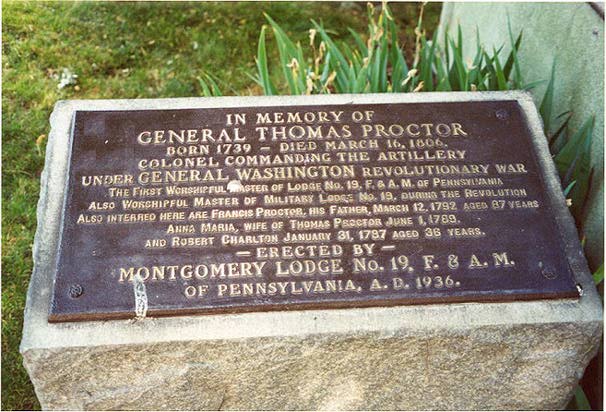
Marker at St. Paul's Episcopal Church, Philadelphia
(US Gen Web Archives)
Thomas Proctor emigrated from Ireland to the Americas with his parents in the 1740s or 1750s and proceeded to establish himself as a carpenter in western Pennsylvania and later in the Philadelphia area. In 1775, he was commissioned as a captain by the Pennsylvania Council of Safety and raised the state's first company of artillery. In August 1776, his grew to a battalion, with Proctor, now a major, in command. Over the winter of 1776/1777, Proctor took temporary command of the entire Continental artillery establishment while Knox was on leave from the army. In the spring, the Pennsylvania Artillery Battalion was expanded to a regiment (Proctor was promoted to colonel) and then transferred to Continental service as Proctor's Continental Artillery Regiment.

As the Pennsylvania Artillery Battalion, Proctor's men fought bravely at Trenton and at the battle of the Assunpink. In 1777, a detachment from Proctor's regiment lost its guns at Bound Brook, and another detachment lost some or all of its pieces when Knyphausen's division stormed across Chadd's Ford at the battle of Brandywine. Now officially the Proctor's Continental Artillery Regiment, Proctor's men fought at Germantown, where it unsuccessfully bombarded the Chew House. The regiment served at the battle of Monmouth, where it may have provided the source for the legend of Molly Pitcher. In 1779, the regiment acquired a number (the 4th Continentals) and went as part of Sullivan's Expedition. Returning to the main army, the regiment fought in smaller battles around New York. In 1781, it went south with Wayne as part of his command in Virginia, but by this time Proctor had left the regiment, and the army, resigning over a dispute with the Pennsylvania government over who could issue commissions to command the regiment's companies. The 4th served at the siege f Yorktown and was finally dissolved in 1783.

The uniform of Proctor's regiment was consistently blue regimentals with red facings. Apparently when some of the army's artillery went to black coats faced red, Proctor refused; the change never took hold fully, and the army switched back later to blue faced red. Proctor's regiment included a band of music (dressed in red coats, given a request from Proctor to the Clothier General) at one point, who played for the commander in chief's birthday celebration at Valley Forge in 1778.

(Note: military bands, often civilian contractors paid by the regimental commander rather than serving soldiers, were distinct from the "field music"--fifers and drummers--who signaled orders and provided drill cadences. A regimental band of music generally consisted of hautbois (oboes), bassoons, serpents, and/or trumpets and played for ceremonial and social functions.)

For a look at some Continental Artillery dressed as Proctor's probably were, see Giles Allison's American Artillery (5) post. For his version of Molly Pitcher, see American Artillery (3).

Wednesday, September 7, 2016

Project 1777: Lincoln, Wayne, and the Pennsylvanians

The first engagement of the 1777 Philadelphia campaign, to my mind, was the British attack on Bound Brook. It served as the transition between the winter's Forage War, the petite guerre of outposts and ambuscades, and the opening of General Lord Howe's field campaign, the attempt to draw General George Washington and the American army into an open battle.

Ewald's map of the engagement at Bound Brook (Wikimedia)
Bound Brook also served as Major General Benjamin Lincoln's first and last engagement as commander of the 4th Division of the Main Army. Lincoln had taken command of the division shortly after receiving his major general's commission from Congress in February 1777. Only one regiment (the 8th Pennsylvania) from his division fought at Bound Brook, along with a few Pennsylvania and New Jersey militia units and a Pennsylvania artillery company, Proctor's.  In July, three months after the brief skirmish on the Raritan, Lincoln was riding north, along with Major General Benedict Arnold and Colonel Daniel Morgan--two tough and unconventional fighters--to assist in the defense of the Northern Department. General George Washington ordered Brigadier General Anthony Wayne to take charge of the division in Lincoln's absence.

Wayne and horse by Alonzo Chappel (Wikimedia)
Anthony Wayne

Wayne was the son and grandson of immigrants. His grandfather, Captain Anthony Wayne, served in the Anglo-Dutch army of William of Orange against the Jacobites in 1690 and later brought his Dutch wife and young son Isaac to Pennsylvania from Ireland in 1699. Isaac, our Anthony's father, served as an officer in the Pennsylvania Military Association (the volunteer defense force that protected the colony during the French and Indian War because the Quaker-owned colony refused to establish a militia) and in due course took over running the family estate as well as the tanning business his father had established, which had grown to be the largest in Pennsylvania. Young Anthony sought a more exciting life and, after studying at his uncle's private academy and the College of Pennsylvania, he became a surveyor, working for Benjamin Franklin and other Philadelphia land speculators. Chester County electors sent him to the Provincial Assembly in 1774, and he joined many of the revolutionary organizations (the Provincial Committee of Safety, the Provincial Convention, and the Committee of Correspondence) that sprang up as war came closer.

In 1776, Wayne was appointed colonel of the 4th Pennsylvania Battalion (later the 5th Pennsylvania Regiment). He commanded the regiment through an ignominious campaign in Canada and was left in command of Fort Ticonderoga when senior officers abandoned it for the warmer and better-supplied surroundings of the Main Army and Congress. In February 1777, Wayne was among those promoted to brigadier general, and he was summoned south to take up command of the 1st Pennsylvania Brigade.

"Dandy Wayne" (he took pleasure in dressing well) studied military arts and sciences as many Americans did, by reading everything and anything of a professional military nature that he could get his hands on. He swore like a sailor, drove his men hard, but asked nothing from them (like bravery or self-discipline) that he didn't expect from himself. He assumed a bold manner; one fellow Pennsylvania officer compared him to the French Marshal-General the Duc de Villars, who was as renowned for his braggadocio as for his bravery. While fierce and boastful, Wayne was calm, almost ice-cold in action, so much so that later in the war Washington selected him on several occasions for special commands that required a brave but cool-headed officer, such as the Corps of Light Infantry's attack on Stony Point in 1779.

1st Pennsylvania Regt. colour (http://www.vssr.org)

The Pennsylvania Division

As the 1777 campaign opened, the 4th or Pennsylvania Division of the Main Army consisted of two brigades, one of five regiments and one of four. Although the artillery doctrine devised by Washington and the army's artillery chief, Brigadier General Henry Knox, called for a company of two to four guns to support each brigade, these companies were not formally allocated as part of the divisional organization. As brigades were formed mostly from troops from one state or region, the army tried to arrange that supporting artillery would come from the same state or region. In 1777, the Pennsylvania Division was often supported by gunners from the command of the Irishman-turned-Pennsylvanian Thomas Proctor.

The First Pennsylvania Brigade

With the departure of Lincoln and Wayne's shift to divisional command (though it came with no promotion--Wayne was not commissioned as a major general until 1783), the 1st Pennsylvania Brigade was commanded by Colonel Thomas Hartley.

Hartley was an attorney who practiced in York and Philadelphia and who served in Pennsylvania's Provincial Convention in 1775. He held commissions first as lieutenant and then as lieutenant colonel in the Associators. He the commanded the 6th Pennsylvania Battalion as lieutenant colonel during its service in Canada in 1776. In 1777 Congress authorized Washington to raise several additional regiments to supplement those allocated to specific states. With lobbying from Richard Henry Lee, Hartley obtained the commission to raise one of these and spent the spring raising it and attending to other matters (for an entertaining correspondence between Hartley and an increasingly annoyed Washington, see this page at the National Archives).

1st Pennsylvania Regiment
One of the first units raised in the war, this regiment started out as Thompson's Rifle Battalion or the Pennsylvania Rifle Regiment. Several companies were sent on Arnold's expedition to Canada, while the remainder served in the siege of Boston. After the siege ended, and with Col. William Thompson promoted to brigadier general, the regiment became the 1st Continental Regiment, under the command of Lt. Col., later Col. Edward Hand. A new name change saw the regiment re-titled the 1st Pennsylvania Regiment, and as such it fought at Long Island, providing the army's rearguard in that action.It fought at Harlem Heights and White Plains. When Washington led the army across the Delaware to attack Trenton, the 1st Pennsylvania led the way in the battles of Trenton, Assunpink Creek, and Princeton.

In early 1777, Hand too was promoted to brigade command and Col. James Chambers took command of the 1st. Under Chambers' command the regiment fought at Brandywine, Paoli, and Germantown and was prepared to engage at White Marsh. In 1778, the regiment exchanged its rifles for muskets and bayonets and as regular infantry fought at the battle of Monmouth. The regiment's light company took part in the storming of Stony Point under Anthony Wayne.

In 1777, the uniform of the 1st Pennsylvania was brown regimentals faced green, but when in the field the unit more often wore hunting shirts and linen or deerskin overalls. In 1776, Col. Hand had ordered material for shirts that were intended to be green, trimmed in red. Similar outfits were often made of brown, black, white, or "drab" cloth. Another account suggests that the 1st received green regimentals (possibly faced red) in the winter of 1776 and green hunting shirts with buckskin breeches. Though he didn't paint them specifically to be the 1st Continental/1st Penna., Giles Allison features some well painted American riflemen on his Tarleton's Quarter blog here and also here.

2nd Pennsylvania Regiment
Originally formed in 1775 as the 1st Pennsylvania Battalion, this unit served in the invasion of and then retreat from Canada and the defense of Lake Champlain. IN 1776 it was reorganized as the 2nd Pennsylvania Regiment and fought at Trenton and Princeton. Its colonel, John Phillip DeHaas, was promoted to brigadier general. A replacement colonel was appointed but did not take command of the regiment before he resigned in the summer of 1777. In the meantime, the regiment was commanded by Major William Williams.

Some sources suggest the regiment took part in the action at Bound Brook. It certainly fought at Brandywine, Paoli, and Germantown (where Maj. Williams was captured). It was present at Whitemarsh, fought at Monmouth, and served throughout the rest of the war.

In 1777, the uniform of the 2nd Pennsylvania was brown regimentals faced green. For some handsomely painted 2nd PAs, see Giles Allison's Tarleton's Quarter blogpost here.

Division flag of the 7th Pennsylvania (www.vssr.org)
7th Pennsylvania Regiment
Commanded in 1777 by Colonel David Geier. The 7th Pennsylvania was raised in 1776 as the 6th Pennsylvania Battalion, which served in Canada and in the defense of Lake Champlain in that year. In January 1777, it was reorganized as the 7th, in which capacity it served in the campaigns in northern New Jersey, in defense of Philadelphia, and in 1778 at the battle of Monmouth.

In 1776, the 6th Battalion may have worn blue regimentals faced red, and it appears that the 7th Pennsylvania retained these. Another possibility is that they wore brown coats faced red.

10th Pennsylvania Regiment
Originally raised by Colonel Adam Penrose, who led it in combat at Princeton, the 10th was commanded in 1777 by Lieutenant Colonel Adam Hubley. It fought at Brandywine, Paoli, and Germantown and the next year at Monmouth. When the 11th was combined into the 10th in 1778, Col. Richard Humpton took command of the consolidated unit.

I have not been able to find a reliable indication of the 10th's uniforms, so one can only made educated guesses. The uniforms adopted by the Military Association in 1775 had been almost all variations on brown regimental coats, while the two Pennsylvania state units (a rifle regiment and a musketry battalion) had worn blue coats faced white. The Pennsylvania Continental regiments of 1776 had been uniformed in blue faced red, blue faced white, brown faced green, and brown faced red. When officers bought cloth for additional coats in late 1777 the majority were blue faced red, with smaller quantities of blue faced white, brown faced white, and brown faced green.

Hartley's Additional Continental Regiment
Hartley being in command of the brigade, his regiment was commanded by Lieutenant Colonel Morgan Connor. Hartley had recruited Connor (or Conner or Conneer or O'Connor, spellings varied) from the 1st Pennsylvania Regiment, which he had joined in 1775, serving at Boston and later at Trenton, where he was wounded. An Irish Roman Catholic, Connor had also served twice as a staff officer in South Carolina and would go on to command other Pennsylvania regiments before becoming the Continental Army's adjutant general. He received sick leave in 1779 and was lost at sea when traveling to the West Indies for a rest cure.

Recruited from Pennsylvania, Maryland, and Delaware, the regiment was barely made up in time to join the spring 1777 campaign. It fought at Brandywine, Paoli, and Germantown during that year. In 1778, it was moved to the Pennsylvania frontier to fight Indians, and in 1779 it joined several other regiments in being subsumed into the "new" 11th Pennsylvania.

In 1777, Hartley's Additional Regiment was uniformed in blue regimental coats faced white.You can see some well-painted Hartley's here.

Next Post: the Second Pennsylvania Brigade and Proctor's Artillery

Tuesday, August 30, 2016

Project 1777: the American Army of the Philadelphia Campaign

Like any great epic, our narrative of 1777 sometimes takes us backward as well as forward. The next step in Project 1777 is to look at the American force engaged in the campaign. But before we can understand what they are, we have to know where they came from.

Bunker Hill by Don Troiani (artist's website)
From Humble Beginnings


The American Army of 1775 had been a gathering of militia companies, begun by Massachusetts and coming to include contingents from all the New England provinces. This was refined and polished into a regular army of sorts by a cadre of political-military leaders, many of them veterans of the late war with France and Spain or self-taught students of the military arts. The new Continental government adopted this army and in 1776 began expanding it, gradually turning what were at first a collection of separate, Provincial forces into a Continental Army. The following year of war tested the army's officers and men; the fire of combat began melting away the dross of cowards and incompetents (though many brave and bold men were also lost in that year of successive disasters for the Continental Army).

But though by the end of 1776, the men of the Continental Army were becoming veterans, they were also disappearing. Since the army had been raised, like previous Provincial forces, to address a short-term emergency, the army of 1776 melted away as enlistments expired and privations increased. For 1777, a new army would have to be recruited, an army that would serve for the duration of the war. Congress would need to work more closely with the commanders of its army and their staffs, so as to ensure that they built together a stronger, more professional, better trained and equipped, more durable and effective army.

After the defeats of the New York campaign in 1776, General George Washington had taken his army across the Jerseys and across the barrier of the broad Delaware River to temporary safety in Pennsylvania. To increase the value of this barrier, he had gathered up or destroyed as many boats as possible along the navigable course of the river, so as to prevent the British from pursuing him across it. After the winter campaign of 1776/1777 in which he defeated the Crown Forces at Trenton and Princeton, he changed plans and withdrew into the Watchung Mountains of New Jersey instead of back across the Delaware. The mountains provided almost as much protection as the river from a swift British approach, and he could move down out of them more easily and quickly than he could cross the river.

Reforging the Blade

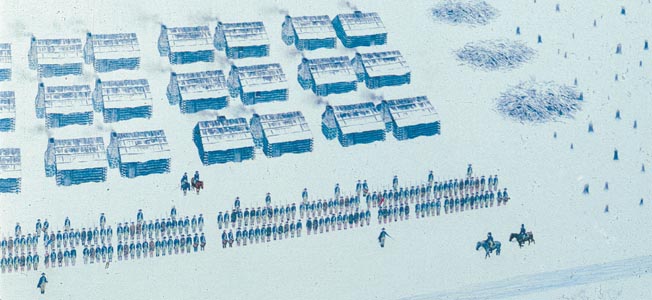
Continental Army encampment at Morristown (warfarehistorynetwork.com)
Behind his mountain barrier, Washington rebuilt his entire army. While reorganizing or enlisting the infantry
that made up the bulk of the army was perhaps the largest task, the artillery, cavalry, staff, and logistical elements of the army also received considerable attention and, as far as possible, upgrades. Congress authorized the creation or transfer of cavalry units from the provinces to create the army's first four regiments of light dragoons, troops that Washington saw more valuable as reconnaissance and intelligence assets than as battlefield troops. Artillery units were likewise reorganized and transferred from the control of the colonies' service to that of Congress. Guns were given new, lighter carriages to increase the speed with which they could move to support the infantry. The army was reorganized into divisions and brigades, each with their own commanding officers, infantry regiments, and artillery brigades, which made supplying, planning, and commanding the army in battle easier. Washington overhauled his staff, finding replacements for the young men of his "family" who had been promoted to command some of the new regiments that Congress was putting into the field. And new logistical and support organizations ensured that arms were manufactured and procured more systematically and that uniforms and comestibles were better accounted for and supplied to the army.

But while this new army was being assembled, Washington relied heavily on what he felt to be a rather weak or broken reed--the state militias. The New Jersey militia had become very animated by the damage done by British and Hessian troops over the autumn and winter, and the combats between militia units and occupying troops looking for supplies became known as the Forage War. Normally such engagements would be quite limited in scope, but as the ferocity of encounters grew and desire on both sides to draw the enemy into a grave trap increased, so did the size of battles. In the fight at Spanktown in February 1777, nearly an entire division was engaged on both sides.

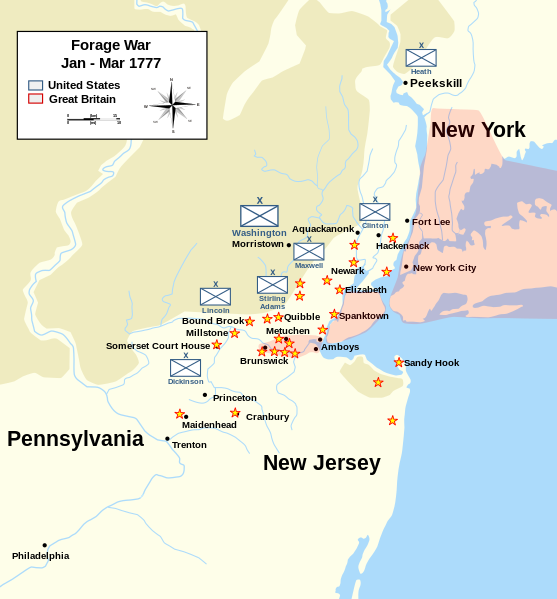
Engagements of the Forage War (Wikimedia)
The Small War

Washington had been explicit in his discussions with his own staff and with Congress about his desire to avoid an open field battle with the British army, at least while his forces were smaller, less experienced, and less well supported than their opponents. He knew the value of fighting from fixed positions, but he also knew that the British would do their best to maneuver in such a way as to force him out of any works he should build, if they could possibly do so. Moreover, if he simply immured his command in a fortress, it would be unable to protect the countryside around it and risk a siege in which he might lose the entire army and its supplies at once. So he wanted to keep tabs on what the British were doing, so he would have plenty of time to react.

In any war, keeping tabs on the enemy is part of the art and craft of reconnaissance. You want to know where the enemy is, what his numbers and equipment are, what he's doing, and if he shows any sign of moving, and if so where he may be going. (Reconnaissance also covers things like knowing the lay of the land, both around your current position and anywhere you or your enemy might want to move, what the state of local population is, where you may be able to find more supplies, and things of that sort.) And ideally one finds those things out very close to the enemy, so you have time to react to any changes, rather than close to your position, where you may not have time to use the information you find.

The enemy, of course, would like the same information about your forces, the local population, and the local terrain. And both of you want to prevent the other from gaining all of this useful knowledge. So between two armies there will be a mass of scouts, spies, counter-scouts, guards, patrols, and outposts.

Of course, the 18th century being what it was, there was no real staff college to learn this sort of thing, but numerous helpful military gentlemen had published manuals on how this sort of thing was done. Several of these guides were to be found in Washington's personal camp library. (PDF) Another would be written by one of the Revolution's leading practitioners of Partisan Warfare.

In its essence, the idea was to have a series of posts, or "guards," between your lines and your enemy's. These would send out patrols to gain information and other patrols to prevent his scouts from getting any information. Each guard would be small, and behind several of them, closer to your army, you would have a smaller number of larger posts or "grand guards" ready to reinforce any guard that might be attacked, to supply troops to relieve those that had been on guard duty for a long time, and occasionally to mount small attacks on the enemy's guards and grand guards so as to disrupt their operations, do some minor damage, and generally be a nuisance. The attack at Bound Brook in April 1777 was just one of these.

This sort of skirmishing or "small war" (la petite guerre as it was called in French, kleiner Krieg in German, or la guerrilla as it was known in Spanish) went on all winter (the Forage War was part of it). On the American side, the New Jersey militia had been invaluable for it, both because of their local knowledge and because at times they made up the bulk of the American army! At several points during the winter and spring, senior Continental officers gave thanks that the British seemed to have no impetus to probe harder, because they might have found nothing but a shell or framework of an opposing force. In March, Washington confided to a Congressman from Pennsylvania that he had barely 4,000 men under arms, while he believed the British had 10,000 (in fact, the British had closer to 15,000).

From Small War to War in Earnest

So what was the state of this American army, replenished and reinforced, ready to take on the British lion? In the next post, we'll look at the American forces in some detail, starting with the divisions of Anthony Wayne (who took over Lincoln's command after Bound Brook, when the latter was sent north to assist Major General Philip Schuyler defend New York State from Burgoyne's expedition) and of Nathanael Greene (whose division served as supports to Lincoln's Bound Brook outpost and which held the cream of the troops from the Commander in Chief's home state).

Wednesday, May 11, 2016

Project 1777: Addendum concerning orders of battle.

"So, what does that mean, again?" (siftingthepast.com)
Some folks have asked about my system of notation on orders of battle.

The larger number next to a unit is its historical strength, or my best approximation of it. The number in brackets is the number of stands used in the game to represent it.

Additionally, I should perhaps explain "wings". Because units, especially British units, often used very wide spacing between files, large units became hard for a commander to maneuver easily. So units over about 300 or 400 men were often broken into two subunits or wings that operated as separate units. Thus, for instance, the Queens Rangers at Short Hills are a 400-man battalion represented on the tabletop by two 4-stand wings.

As far as troops go, most will have muskets of some quality. I'm relying on research in historic records that a friend of mine did many years ago to determine which American units are likely to have been provided with bayonets.

Only a few units on the American side, and on the British side the German jaegers and a few units of Provincials carried rifles throughout. There isn't any way in C&G, currently, to reflect the practice of arming one company of a battalion, or one platoon of a company, with rifles, as the Crown Forces often did, other than treating that body as a separate unit. That's more the province of a lower-echelon game, where individual platoons are the maneuver units.

I'll add commander ratings later on, after I've had time to do a little more research and evaluation.  But at the higher level my read is that Cornwallis and Greene were some of the best general officers who served during the war, both in terms of tactical insight, organizational skill, and their ability to inspire and motivate their men. Alexander was undeniably brave, but a bit foolhardy. Grant was well-connected (a good friend of Howe's and with experience of and friends in British political circles) but alternated between rash boldness and overconfident torpor.

Carl von Donop (Wikipedia)
Von Donop sounds to have been a bit of a martinet, but generally a capable commander; he had good instincts for arranging his posts in New Jersey that were overridden by Howe, and he conducted his withdrawal in the face of the American surprise attack capably and without rush or fuss. His attack on and death at Red Bank seems to have been due more to bad intelligence about the fort and its defenders than anything else.

Benjamin Lincoln is a challenge to rate: he had a largely undistinguished and unsuccessful career as a general officer, being alternately commander of a rear guard that was not hard pressed, commander of reserves that saw no action, surprised and chased out of his billet in his nightshirt, wounded in a pointless skirmish, superintendent of a failed capaign hamstrung by poor troops and lukewarm civilian support, forced into the most humiliating surrender of American forces during the war, and then unsuccessful in his first combat command after returning to the army. On the other hand, Washington seems to have thought fairly highly of him. He recommended Lincoln for a general's commission despite his lack of experience. And he continued to put him in positions of command after repeated reverses. My guess, after a quick read, is that he was an able administrator and competent, if not distinguished, field commander who was simply cursed with some of the worst luck going.

Peter Muhlenberg seems to have been a competent, somewhat inspirational officer. George Weedon sounds as if he were very competent (or connected) given how regularly he was promoted and then tipped for adjutant general, but also hot-headed (given his leaving the service over the question of his senority). Washington seems to have blown hot and cold on him, praising him in 1777 and then many years later damning him with faint praise and implying he was a drinker. My historian friend remarks "I see Weedon and Muhlenberg as fine administrators and solid battlefield commanders (not thrilling but reliable).  Weedon had more fire in his belly early in the war.  Both inspired their men with great confidence."

Saturday, April 30, 2016

Project 1777: the Battle of Short Hills

Apologies, faithful readers! Life has kept me busy with family matters and projects at work that have eaten up my time and energy. Weekend time to devote to work on Project 1777 has been sparse. I still mean to get a playing or two of some of these early skirmishes under my belt, both to re-familiarize myself and some of my comrades with the game system and to test out some of my ratings for the units involved.

Until I can make that happen, though, I have another battle synopsis to share with you. This engagement, though still a bit one-sided historically, could be touched up to make an interesting game a little more easily than Bound Brook.
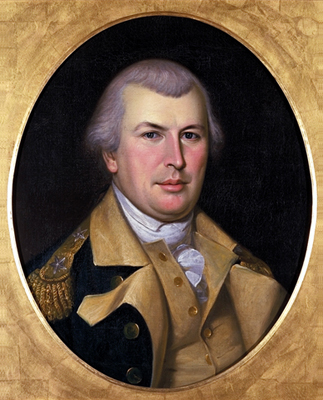
Nathanael Greene (Wikipedia)
Back to 1777

When we last left General Sir William Howe, his ploy to draw the American Army into a trap at their forward post of Bound Brook had failed. Lt. Gen. Lord Cornwallis had surrounded and attacked the American post, chasing off Maj. Gen. Benjamin Lincoln in his nightshirt (possibly even without that!) and capturing several cannon. But the Americans' nearest supports, Maj. Gen. Nathanael Greene's division, had not arrived to reinforce Lincoln until after the British forces had left. Greene harassed the rearguard of the retreating British, then ensconced himself in Bound Brook.

However, after Greene had waited several weeks to see what else might develop, Lt. Gen. George Washington had pulled Greene's division back, leaving Bound Brook to lie in the debatable zone between the two armies. Bound Brook was too far from the main American position at Morristown to be supported adequately; it was too vulnerable to sudden attack to be a suitable forward base.

Nevertheless, Washington gave Howe some room to hope that the rebel commander could still be drawn out of his fastness in the Watchung Mountains. On May 28th, two days after Greene was recalled from Bound Brook, the American army moved from its winter camp at Morristown to Middlebrook, still in the mountains but closer to the British advanced base at (New) Brunswick.

A Cunning Plan...Foiled

In June, Howe feinted, trying again to bring the Americans down out of the mountains and onto the plains of New Jersey where he hoped to defeat them in detail. Attempting to convince the Americans that he was marching toward the Delaware River and Philadelphia, the American capitol, Howe moved the main British army out of New York into New Jersey and settled for several days at Somerset Court House, south of Brunswick. But spies had told the Americans that the British bridging train, without which they could not cross the Delaware River, had remained in New York. Other supplies had also been left behind, meaning that the British could not stay in the field for long.Washington did not bite on Howe's proffered bait.

William Alexander, Lord Stirling (Hidden New Jersey)
Instead, Washington waited, and when Howe began moving back towards New York, the Americans came down from the mountains into the foothills, shadowing the King's army as it moved back to its base and picking off any stragglers who fell behind on the march. With his main army at the delightfully named Quibbletown, Washington sent an advanced guard under Maj. Gen. William Alexander to harass the British rearguard, much as Greene had chivvied Cornwallis's men after Bound Brook.

Alexander, sometimes known as Lord Stirling because he claimed to have inherited that Scottish title, had a reputation for bravery forged at the battle of Long Island the previous summer. Holding the right of the American line in that battle, Stirling had eventually been surrounded and his command forced to flee or surrender. His force had taken heavy losses, but through its sacrifice it had prevented the encirclement and capture of the entire American army. Alexander was later exchanged for Monfort Browne, the Governor of the Bahamas, who had been captured during an American raid on the islands in March of 1776. After returning to the army, Alexander commanded a brigade under Greene in the winter 1776/1777 campaign, leading the center of the American line at the battle of Trenton.

Now he sought to inflict some losses on the British rear guard as their army retreated to Perth Amboy, from there presumably to return to New York.

Barking at the Heels of the British Army

Howe determined to deal a sharp blow to Alexander's force and, as always, hoped that in the process he could draw the American field army into a decisive battle. Cornwallis, Howe's most aggressive general officer, received command of a strike force designed for speed and power. Cornwallis set off an hour after midnight with a task force of light dragoons, mounted and foot jaegers, the Queen's Rangers, a unit of Guards, and battalions of British and German grenadiers. Howe and Maj. Gen. John Vaughn followed with more jaegers, more British grenadiers, and a force of British light infantry.

A Hessian officer's map of the battle of Short Hills (Wikipedia)
As shown in the map drawn by Friedrich von Wangenheim, a Hessian mounted jaeger officer, Cornwallis' force and that under Howe advanced on parallel road, hunting for Alexander's division. Cornwallis made contact first, his jaegers coming into contact with American riflemen of Morgan's Corps just after dawn. The riflemen fought hard, not falling back until charged with the bayonet. As they were pressed, the riflemen fell back on Ottendorf's Corps, an independent light infantry force commanded by Lt. Col. Charles Armand Tuffin in the absence of its titular leader, and a body of New Jersey infantry--either militia or Continentals from Brig. Gen. William Maxwell's brigade--backed up by several artillery pieces. These supports helped stiffen the riflemen's resistance, but as more troops were deployed from the British column to the attack, the Americans were forced further back.

A Bitter Fight

Charles Armand Tuffin, Marquis de la Rouerie (Wikipedia)
Alexander had selected a defensive position on a ridge running perpendicular to the road. There he placed the main strength of his force, the remainder of Maxwell's brigade and a brigade of Pennsylvanians under Brig. Gen. Thomas Conway. Cornwallis tried to outflank this position by sending a battalion of Hessian grenadiers in a wide sweep around the Americans' left flank, but this was stalled by a battery of four French artillery pieces, carefully concealed in enfilade on a wooded hillside. One Guards officer foolishly attempted to capture the battery single-handed and was shot down at Alexander's direction. But a force of less than 2,000 men, even possessed of good defensive terrain, cannot hold against nearly 4,000 indefinitely. Eventually the pressure of the British attack forced Alexander's troops backwards, through the town of Westfield and over another line of wooded hills to the edge of the Watchung Mountains. The British, exhausted by nearly six solid hours of fighting, set to plundering Westfield. Joined by Howe's column, the expedition camped in area around the town that night and then marched back towards Staten Island the next day by way of Rahway.

Howe had again failed to draw out Washington's army, and he had missed even the prize of surrounding and capturing Alexander's division, though the British did take three of Alexander's four French guns back to New York with them. One amateur historian alleges that Washington heard the initial gunfire between the jaegers and Morgan's riflemen ten or fifteen miles away in Quibbletown and that the terrified commander immediately ordered his main army to begin fleeing back into the Newark Mountains.This seems unlikely, as does the claim that Alexander's fight at Short Hills was a brilliant strategic victory, allowing the main army time to escape a British trap. The trap had been set for Alexander, who did deftly avoid it, but Howe had not expected, when he set out in the dead of night, to encircle the American main army, only its somewhat dangerously advanced guard. One account even goes so far as to suggest that Alexander deliberately ignored an order from Washington to fall back from contact with the British main force; if that is true, Alexander was lucky to keep his command, escape or no.

A Tentative Order of Battle

My preliminary order of battle for this engagement (drawn from returns and assuming that Howe's column proves, as it did historically, to be too far away to support Cornwallis) looks something like this, much smaller than some of the fanciful and inflated numbers of some modern accounts. (Note: The larger number next to a unit is its historical strength, or my best approximation of it. The number in brackets is the number of stands used in the game to represent it: four-figure stands for infantry, two-figure stands for cavalry.)

Major General William Alexander, Lord Stirling (1,800 of all arms)

Lieutenant Colonel Charles Armand Tuffin
Ottendorf's Independent Corps (100 [2]): Line, Trained, Poor, Average
Morgan's Provisional Rifle Corps, detachment (100 [2]): Elite, Crack, Average, Excellent

Brigadier General William Maxwell
1st & 2nd New Jersey Continentals (300 [4]): Line, Trained, Average, Average
3rd & 4th New Jersey Continentals (300 [4]): Line, Trained, Average, Average
Spencer's Additional Continental Regiment (200 [3]): Line, Trained, Poor, Average
New Jersey state artillery (two sections of two four-pounders, 100): Line, Trained, Average, Average

Brigadier General Thomas Conway
3rd & 6th Pennsylvania Continentals (300 [4]): Line, Trained, Poor, Average
9th & 12th Pennsylvania Continentals (300 [4]): Line, Trained, Poor, Average
Pennsylvania state artillery (two sections of two four-pounders, 100) Line, Trained, Average, Average

Lieutenant General Charles, Lord Cornwallis (3,600 of all arms)

Captain James Weymss
Queen's Rangers (400 in two wings of [4] each): Line, Veteran, Average, Good
Ferguson's Rifle Corps (120 [2]): Line, Trained, Average, Excellent
16th Light Dragoons (300 in three squadrons of [1] each): Line, Veteran, Average, Poor 
Royal Artillery (two sections of two six-pounder guns, 100): Elite, Veteran, Average, Good

Brigadier General Carl von Donop
Hesse-Kassel Feld Jaeger Korps, foot companies (100 [2]): Elite, Crack, Good, Excellent
Hesse-Kassel Feld Jaeger Korps, mounted company (80 [1]): Elite, Crack, Good, Excellent
Linsing Grenadier Battalion (430[5]): Elite, Veteran, Good, Poor
Minningerode Grenadier Battalion (430[5]): Elite, Veteran, Good, Poor
Lengerke Grenadier Battalion (440[5]): Elite, Veteran, Good, Poor
Hessian artillery (three sections of two four-pounder guns, 150): Line, Veteran, Average, Good

Lieutenant Colonel Sir George Osborn
1st Foot Guard Battalion (450 in two wings of [5]): Elite, Veteran, Good, Average
2nd Grenadier Battalion (500 in two wings of [5]): Elite, Crack, Good, Average
Royal Artillery (two sections of two three-pounder guns, 100): Elite, Veteran, Average, Good