|
| John Phillip DeHaas by CW Peale (Wikimedia) |
In the (never explained) absence of Dutchman-turned-Pennsylvanian Brigadier General John Phillip DeHaas (formerly of the 2nd Pennsylvania), Colonel Richard Humpton commanded the division's second brigade. A Yorkshireman who had held a King's commission in the British army and fought in France during the Seven Years' War, Humpton had settled in Pennsylvania after that conflict. He was commissioned as a lieutenant colonel, then colonel, in the Pennsylvania Flying Camp in 1776, then given command of the 11th Pennsylvania Regiment in October of 1776 and commanded it through the battle of Trenton.
Humpton commanded the 2nd Brigade in the 1777 campaign, fighting at Brandywine, Paoli, and Germantown. After the battle of Monmouth, the 11th Pennsylvania was merged into the 10th, Humpton taking command of the combined regiment. Following the Pennsylvania Line mutiny of 1781, the 10th was dissolved, and Humpton took command of the 6th Regiment, then headed the 2nd Regiment before he retired in 1783 with the brevet rank of brigadier general.
Humpton became the center of a bitter dispute with Anthony Wayne following the battle of Paoli. Humpton maintained he had been warned of the attack at Paoli by a Scots deserter and that he had attempted to convey the news to Wayne, whom he said mocked him and refused to believe an attack was imminent. Wayne denied any such discussion had taken place and blamed Humpton for reacting slowly and ineffectively with his brigade when the British attacked, forcing Wayne (who claimed to have been alert and prepared to fight) to fall back to avoid encirclement. A court martial eventually acquitted Wayne unreservedly, though it cast no direct aspersion on Humpton.
4th Pennsylvania Regiment
Authorized in late 1775 and raised early in 1776 as the 3rd Pennsylvania Battalion, the unit saw action in the New York campaign. The battalion was detached from the Main Army to help build fortifications around New York and so missed the battle of Long Island. The unit rejoined the Main Army and served in the rest of the battles of the New York campaign, eventually returning to the fortifications it had helped build. A large part of the unit was captured when Fort Washington surrendered to the British. The remainder was reorganized as the 4th Pennsylvania Regiment in January 1777. As such, it fought at Brandywine, Paoli, and Germantown in 1777 and at Monmouth in 1778, and it took part in the genocidal campaign against the Iroquois ordered by Washington and carried out by Major General John Sullivan in 1779.
Of interest, Lambert Cadwalader, a Philadelphia merchant and a member of the Provincial Assembly, served as the lieutenant colonel of the 3rd Battalion and was taken captive at Fort Washington. He was released on parole, and he was appointed colonel and commander of the now renamed 4th Pennsylvania. But as he had not been exchanged (Washington having prohibited the release of British field officers held as prisoners of war), his scruples prevented him from accepting that commission, and he eventually resigned from the army and returned to politics in Pennsylvania. He was elected to the Continental Congress in 1784. In his absence, the regiment seems to have been commanded by by Lt. Col. William Butler, one of five brothers, first-generation immigrants from Ireland, who fought in the Pennsylvania Line during the Revolution.
Deserters from the regiment captured in 1776 suggest that the regiment at that time was uniformed in brown regimentals faced white, buckskin breeches, and hats bound with white tape. A deserter captured the following year wore a hunting shirt, linen trousers, and woolen stockings (no colours given) and had no shoes (!)
5th Pennsylvania Regiment
This regiment originally raised at the 4th Pennsylvania Battalion. It served in Canada and in the defense of Lake Champlain. Moved back to the Main Army from the Canadian and Northern Departments, it was reorganized as the 5th Pennsylvania Regiment. It had been commanded by Anthony Wayne; when he was promoted to brigadier general, command of the 5th was assigned to Colonel Francis Johnson, a friend of Wayne's who had been the 4th Battalion's lieutenant colonel. Johnson commanded the 5th for the rest of the war. Under Johnson, the regiment fought at Brandywine, Paoli, and Germantown. It later fought at Monmouth and Springfield in New Jersey and at Green Spring and Yorktown in Virginia.
The 4th Battalion had been uniformed in blue coats faced white. More coats were issued to the 5th in 1777 by the Clothier General, but I have not been able to ascertain what colour(s) they were. Deserter descriptions from 1777 include a rainbow of clothing, including blue and white or brown and white regimentals, brown or "light-colured" coats, grey or green or blue jackets, purple or yellow hunting shirts, and one blanket coat!
 |
| Col. Daniel Brodhead by CW Peale (Robert Cairns) |
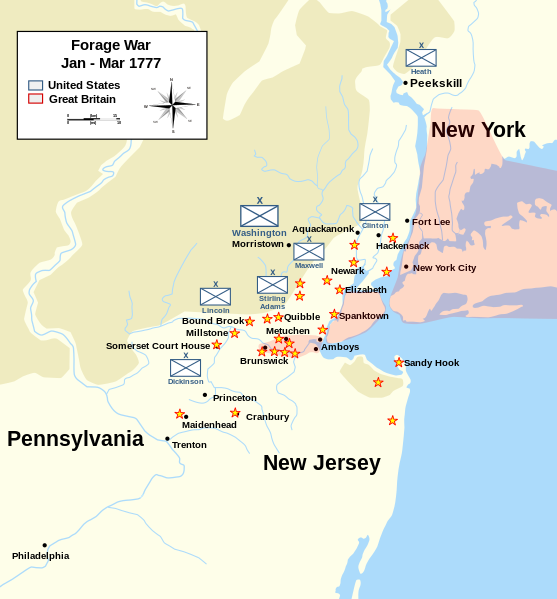
Originally raised as Mackay's Battalion (after its colonel, Aeneas Mackay), this formation was embodied in the far western counties of Pennsylvania as a troop for the defense of the frontier. In January 1777, it was renamed the 8th Pennsylvania Regiment and summoned to join the Main Army in New Jersey. The regiment, lacking tents and even coats for some of its men, suffered considerable loss from its mid-winter march across the state; 50 men died, including the colonel and lieutenant colonel, and many more became ill. After some recovery, the unit took part in the Forage War, including the battle of Spanktown. Colonel Daniel Broadhead transferred from the 4th to command the 8th, while Maj. Richard Butler (another of the "fighting Butlers") was promoted to serve as lieutenant colonel.
The 8th was part of the small garrison of Bound Brook that was severely handled by the British attack. Although most of the regiment got away, the experience, after the grueling trek of January and the loss of their senior officers, put the regiment into what General Washington referred to in a letter as a "distracted State"; disciplinary actions were taken, and an inquiry into the state of the unit was undertaken (conclusions unknown).
In June, the regiment lost its new lieutenant colonel, a captain, and 140 men, who were sent to join Morgan's Rifle Corps in the Northern Department. The hard-luck 8th next participated in Wayne's defeat at Brandywine and at the disaster of Paoli. It was then part of the initially successful assault on the British light infantry at Germantown, helping to chase off the lights and plunder their camp; but circumstances of that confused battle led to the 8th appearing unexpectedly in front of Sullivan's division, which promptly began shooting into the mass of horrified Pennsylvanians.
In 1778, things were not much better, with the 8th dispatched back to the Pennsylvania frontier, where it was involved in Brigadier General Lachlan McIntosh's abortive attempt to invade the Ohio Country. In 1779, the regiment took part in an secondary operation of Sullivan's campaign against the Iroquois. Finally, in 1781 the regiment took part in the Pennsylvania Line mutiny and was disbanded, with its remaining men being consolidated into the new 2nd Pennsylvania.
Deserters after Bound Brook were reported wearing, variously, brown coats, blue coats, and hunting shirts, though none of these are described in terms that convince the reader they were military issue. It may well be that there had been no issue of uniforms to the regiment even as late as that. A portrait of Col. Brodhead from the winter of 1777/1778 shows him in a regimental coat of blue faced red; if the regiment eventually wore these colours, it would be in keeping with the norm for much of the Pennsylvania Line.
11th Pennsylvania Regiment
Humpton's lieutenant colonel, Francis Gurney, presumably commanded the regiment in his absence. The 11th had been raised in September 1776 and had served at Assunpink Creek and at Princeton in that year. In 1777, the regiment fought at Brandywine, Paoli, and Germantown. It was present but saw no action at Whitemarsh. In 1778, it fought at Monmouth; later that year it was consolidated into the 10th Pennsylvania.
The 11th wore blue coats faced red.
Proctor's Artillery
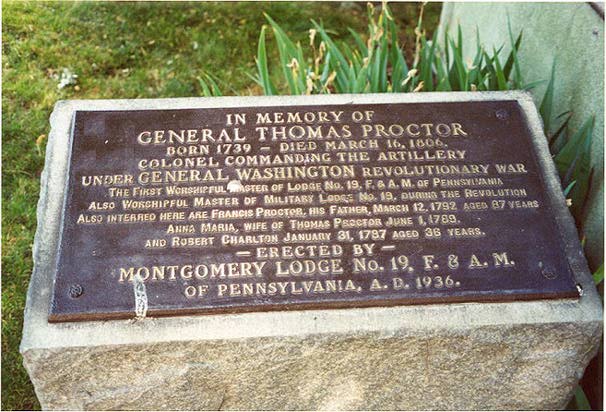 |
| Marker at St. Paul's Episcopal Church, Philadelphia (US Gen Web Archives) |
As the Pennsylvania Artillery Battalion, Proctor's men fought bravely at Trenton and at the battle of the Assunpink. In 1777, a detachment from Proctor's regiment lost its guns at Bound Brook, and another detachment lost some or all of its pieces when Knyphausen's division stormed across Chadd's Ford at the battle of Brandywine. Now officially the Proctor's Continental Artillery Regiment, Proctor's men fought at Germantown, where it unsuccessfully bombarded the Chew House. The regiment served at the battle of Monmouth, where it may have provided the source for the legend of Molly Pitcher. In 1779, the regiment acquired a number (the 4th Continentals) and went as part of Sullivan's Expedition. Returning to the main army, the regiment fought in smaller battles around New York. In 1781, it went south with Wayne as part of his command in Virginia, but by this time Proctor had left the regiment, and the army, resigning over a dispute with the Pennsylvania government over who could issue commissions to command the regiment's companies. The 4th served at the siege f Yorktown and was finally dissolved in 1783.
The uniform of Proctor's regiment was consistently blue regimentals with red facings. Apparently when some of the army's artillery went to black coats faced red, Proctor refused; the change never took hold fully, and the army switched back later to blue faced red. Proctor's regiment included a band of music (dressed in red coats, given a request from Proctor to the Clothier General) at one point, who played for the commander in chief's birthday celebration at Valley Forge in 1778.
(Note: military bands, often civilian contractors paid by the regimental commander rather than serving soldiers, were distinct from the "field music"--fifers and drummers--who signaled orders and provided drill cadences. A regimental band of music generally consisted of hautbois (oboes), bassoons, serpents, and/or trumpets and played for ceremonial and social functions.)
For a look at some Continental Artillery dressed as Proctor's probably were, see Giles Allison's American Artillery (5) post. For his version of Molly Pitcher, see American Artillery (3).