Background image is Les Dernières Cartouches (The Last Cartridges) by Alphonse de Neuville
Showing posts with label order of battle. Show all posts

Saturday, April 30, 2016

Project 1777: the Battle of Short Hills

Apologies, faithful readers! Life has kept me busy with family matters and projects at work that have eaten up my time and energy. Weekend time to devote to work on Project 1777 has been sparse. I still mean to get a playing or two of some of these early skirmishes under my belt, both to re-familiarize myself and some of my comrades with the game system and to test out some of my ratings for the units involved.

Until I can make that happen, though, I have another battle synopsis to share with you. This engagement, though still a bit one-sided historically, could be touched up to make an interesting game a little more easily than Bound Brook.
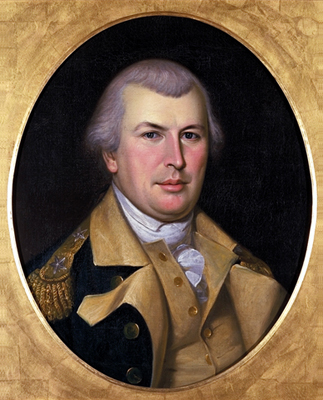
Nathanael Greene (Wikipedia)
Back to 1777

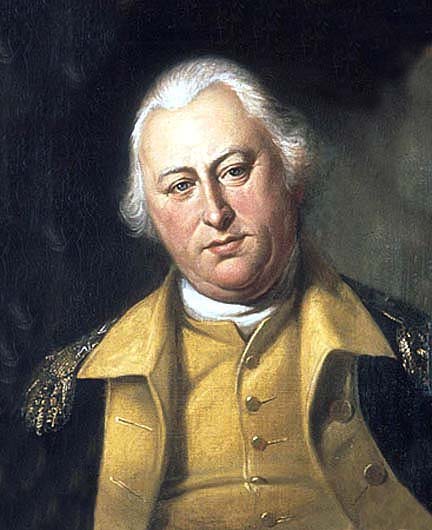
When we last left General Sir William Howe, his ploy to draw the American Army into a trap at their forward post of Bound Brook had failed. Lt. Gen. Lord Cornwallis had surrounded and attacked the American post, chasing off Maj. Gen. Benjamin Lincoln in his nightshirt (possibly even without that!) and capturing several cannon. But the Americans' nearest supports, Maj. Gen. Nathanael Greene's division, had not arrived to reinforce Lincoln until after the British forces had left. Greene harassed the rearguard of the retreating British, then ensconced himself in Bound Brook.

However, after Greene had waited several weeks to see what else might develop, Lt. Gen. George Washington had pulled Greene's division back, leaving Bound Brook to lie in the debatable zone between the two armies. Bound Brook was too far from the main American position at Morristown to be supported adequately; it was too vulnerable to sudden attack to be a suitable forward base.

Nevertheless, Washington gave Howe some room to hope that the rebel commander could still be drawn out of his fastness in the Watchung Mountains. On May 28th, two days after Greene was recalled from Bound Brook, the American army moved from its winter camp at Morristown to Middlebrook, still in the mountains but closer to the British advanced base at (New) Brunswick.

A Cunning Plan...Foiled

In June, Howe feinted, trying again to bring the Americans down out of the mountains and onto the plains of New Jersey where he hoped to defeat them in detail. Attempting to convince the Americans that he was marching toward the Delaware River and Philadelphia, the American capitol, Howe moved the main British army out of New York into New Jersey and settled for several days at Somerset Court House, south of Brunswick. But spies had told the Americans that the British bridging train, without which they could not cross the Delaware River, had remained in New York. Other supplies had also been left behind, meaning that the British could not stay in the field for long.Washington did not bite on Howe's proffered bait.

William Alexander, Lord Stirling (Hidden New Jersey)
Instead, Washington waited, and when Howe began moving back towards New York, the Americans came down from the mountains into the foothills, shadowing the King's army as it moved back to its base and picking off any stragglers who fell behind on the march. With his main army at the delightfully named Quibbletown, Washington sent an advanced guard under Maj. Gen. William Alexander to harass the British rearguard, much as Greene had chivvied Cornwallis's men after Bound Brook.

Alexander, sometimes known as Lord Stirling because he claimed to have inherited that Scottish title, had a reputation for bravery forged at the battle of Long Island the previous summer. Holding the right of the American line in that battle, Stirling had eventually been surrounded and his command forced to flee or surrender. His force had taken heavy losses, but through its sacrifice it had prevented the encirclement and capture of the entire American army. Alexander was later exchanged for Monfort Browne, the Governor of the Bahamas, who had been captured during an American raid on the islands in March of 1776. After returning to the army, Alexander commanded a brigade under Greene in the winter 1776/1777 campaign, leading the center of the American line at the battle of Trenton.

Now he sought to inflict some losses on the British rear guard as their army retreated to Perth Amboy, from there presumably to return to New York.

Barking at the Heels of the British Army

Howe determined to deal a sharp blow to Alexander's force and, as always, hoped that in the process he could draw the American field army into a decisive battle. Cornwallis, Howe's most aggressive general officer, received command of a strike force designed for speed and power. Cornwallis set off an hour after midnight with a task force of light dragoons, mounted and foot jaegers, the Queen's Rangers, a unit of Guards, and battalions of British and German grenadiers. Howe and Maj. Gen. John Vaughn followed with more jaegers, more British grenadiers, and a force of British light infantry.

A Hessian officer's map of the battle of Short Hills (Wikipedia)
As shown in the map drawn by Friedrich von Wangenheim, a Hessian mounted jaeger officer, Cornwallis' force and that under Howe advanced on parallel road, hunting for Alexander's division. Cornwallis made contact first, his jaegers coming into contact with American riflemen of Morgan's Corps just after dawn. The riflemen fought hard, not falling back until charged with the bayonet. As they were pressed, the riflemen fell back on Ottendorf's Corps, an independent light infantry force commanded by Lt. Col. Charles Armand Tuffin in the absence of its titular leader, and a body of New Jersey infantry--either militia or Continentals from Brig. Gen. William Maxwell's brigade--backed up by several artillery pieces. These supports helped stiffen the riflemen's resistance, but as more troops were deployed from the British column to the attack, the Americans were forced further back.

A Bitter Fight

Charles Armand Tuffin, Marquis de la Rouerie (Wikipedia)
Alexander had selected a defensive position on a ridge running perpendicular to the road. There he placed the main strength of his force, the remainder of Maxwell's brigade and a brigade of Pennsylvanians under Brig. Gen. Thomas Conway. Cornwallis tried to outflank this position by sending a battalion of Hessian grenadiers in a wide sweep around the Americans' left flank, but this was stalled by a battery of four French artillery pieces, carefully concealed in enfilade on a wooded hillside. One Guards officer foolishly attempted to capture the battery single-handed and was shot down at Alexander's direction. But a force of less than 2,000 men, even possessed of good defensive terrain, cannot hold against nearly 4,000 indefinitely. Eventually the pressure of the British attack forced Alexander's troops backwards, through the town of Westfield and over another line of wooded hills to the edge of the Watchung Mountains. The British, exhausted by nearly six solid hours of fighting, set to plundering Westfield. Joined by Howe's column, the expedition camped in area around the town that night and then marched back towards Staten Island the next day by way of Rahway.

Howe had again failed to draw out Washington's army, and he had missed even the prize of surrounding and capturing Alexander's division, though the British did take three of Alexander's four French guns back to New York with them. One amateur historian alleges that Washington heard the initial gunfire between the jaegers and Morgan's riflemen ten or fifteen miles away in Quibbletown and that the terrified commander immediately ordered his main army to begin fleeing back into the Newark Mountains.This seems unlikely, as does the claim that Alexander's fight at Short Hills was a brilliant strategic victory, allowing the main army time to escape a British trap. The trap had been set for Alexander, who did deftly avoid it, but Howe had not expected, when he set out in the dead of night, to encircle the American main army, only its somewhat dangerously advanced guard. One account even goes so far as to suggest that Alexander deliberately ignored an order from Washington to fall back from contact with the British main force; if that is true, Alexander was lucky to keep his command, escape or no.

A Tentative Order of Battle

My preliminary order of battle for this engagement (drawn from returns and assuming that Howe's column proves, as it did historically, to be too far away to support Cornwallis) looks something like this, much smaller than some of the fanciful and inflated numbers of some modern accounts. (Note: The larger number next to a unit is its historical strength, or my best approximation of it. The number in brackets is the number of stands used in the game to represent it: four-figure stands for infantry, two-figure stands for cavalry.)

Major General William Alexander, Lord Stirling (1,800 of all arms)

Lieutenant Colonel Charles Armand Tuffin
Ottendorf's Independent Corps (100 [2]): Line, Trained, Poor, Average
Morgan's Provisional Rifle Corps, detachment (100 [2]): Elite, Crack, Average, Excellent

Brigadier General William Maxwell
1st & 2nd New Jersey Continentals (300 [4]): Line, Trained, Average, Average
3rd & 4th New Jersey Continentals (300 [4]): Line, Trained, Average, Average
Spencer's Additional Continental Regiment (200 [3]): Line, Trained, Poor, Average
New Jersey state artillery (two sections of two four-pounders, 100): Line, Trained, Average, Average

Brigadier General Thomas Conway
3rd & 6th Pennsylvania Continentals (300 [4]): Line, Trained, Poor, Average
9th & 12th Pennsylvania Continentals (300 [4]): Line, Trained, Poor, Average
Pennsylvania state artillery (two sections of two four-pounders, 100) Line, Trained, Average, Average

Lieutenant General Charles, Lord Cornwallis (3,600 of all arms)

Captain James Weymss
Queen's Rangers (400 in two wings of [4] each): Line, Veteran, Average, Good
Ferguson's Rifle Corps (120 [2]): Line, Trained, Average, Excellent
16th Light Dragoons (300 in three squadrons of [1] each): Line, Veteran, Average, Poor 
Royal Artillery (two sections of two six-pounder guns, 100): Elite, Veteran, Average, Good

Brigadier General Carl von Donop
Hesse-Kassel Feld Jaeger Korps, foot companies (100 [2]): Elite, Crack, Good, Excellent
Hesse-Kassel Feld Jaeger Korps, mounted company (80 [1]): Elite, Crack, Good, Excellent
Linsing Grenadier Battalion (430[5]): Elite, Veteran, Good, Poor
Minningerode Grenadier Battalion (430[5]): Elite, Veteran, Good, Poor
Lengerke Grenadier Battalion (440[5]): Elite, Veteran, Good, Poor
Hessian artillery (three sections of two four-pounder guns, 150): Line, Veteran, Average, Good

Lieutenant Colonel Sir George Osborn
1st Foot Guard Battalion (450 in two wings of [5]): Elite, Veteran, Good, Average
2nd Grenadier Battalion (500 in two wings of [5]): Elite, Crack, Good, Average
Royal Artillery (two sections of two three-pounder guns, 100): Elite, Veteran, Average, Good

Tuesday, February 2, 2016

Project 1777: The State of the War in the Spring of 1777 and the battle of Bound Brook

Prologue
Sir William Howe (Anne SK Brown MHC)


Depending on how one chooses to date, 1777 might be said to have been the third year of the American Revolution. In 1775, the frequently violent political unrest in New England had become open warfare when British troops, searching for cannon stolen from the militia depot in Boston, came under fire from American rebels in Lexington and Concord. After the sanguinary battle of Bunker Hill, a siege of Boston had ensued. This was brought to a head in January 1776 by the arrival at the siege of a "noble train of artillery", cannon, howitzers, and mortars from the captured British fort at Ticonderoga, weapons that, once emplaced on Dorchester Heights, rendered the city indefensible. In March the British army evacuated Boston for Halifax, Nova Scotia, where it was retrained and reinforced.

In late June and early July of 1776, the British army under its commander in chief General William Howe sailed south to New York; in August they landed on Long Island and chased the American army from their positions there. September saw the British occupy Manhattan while the American army fell back to Harlem. In October the Americans lost another battle at White Plains. They fell back into New Jersey in November after the loss of Forts Washington and Lee, then fell back before another British advance, ending the year in Pennsylvania.

Gen. Geo. Washington, 1776 (Brooklyn Museum)
Although his army was exhausted and about to dissolve as enlistments expired, Continental commander in chief Gen. George Washington persuaded his men to make one more effort. In a lightning strike, he attacked the British Army's outpost at Trenton on Christmas Day, 1776, retreated, and attacked again in a feint at Brunswick, the main British depot in the Jerseys. Under pressure from a British sally from New York under Lt. Gen. Lord  Cornwallis, Washington conducted an effective fighting withdrawal to a strong defensive position on Assunpink Creek, then stole a march on the British, attacking their rear echelon at Princeton, before falling back to winter quarters at Morristown in New Jersey's Watchung Mountains.

After doing nothing but taking body blows for a year, the American army had retorted with several shrewd jabs. It could not yet take on the British Army in the field without a tremendous advantage in numbers or position, but British hopes for a speedy end to the war with a quick victory over green militia had been decisively dashed. The Americans meant to fight.

1777: What Next?
Howe (now Sir William, after being knighted for his successful campaign in New York) began the new year with a divided command and a strategic puzzle. The main portion of his army was in and around New York City; it had spent the rest of the winter fighting a bitter petite guerre, a war of outposts and skirmishes, with the Americans over what supplies could still be foraged in the Jerseys. Now that Spring was drawing near, Howe wanted to find some way to come to grips with Washington and his army. But as Commander in Chief in North America, Howe's responsibilities (and available forces) lay beyond just the army in New York.

Another portion of the army held Rhode Island; a relatively simple operation the previous year under Lt. Gen. Lord Percy and Maj. Gen. Henry Clinton had seized Newport as a foothold in New England for the Crown Forces. (Clinton had earlier tried without success to capture the southern city of Charleston, South Carolina.)

Canada had originally held a small garrison under General Guy Carleton. This force had proved sufficient to fight off a confused and undersupported attempt to invade Canada by various American forces in 1775. Carleton's counteroffensive in 1776 had gotten far enough to drive American naval forces from Lake Champlain, but he had not done so soon enough to allow him also to recapture Fort Ticonderoga, the crucial base at the south end of the lake, from the rebels before winter set in.

Maj. Gen. Burgoyne (Frick Collection)
And in the meanwhile, Maj. Gen. John Burgoyne, having undermined Carleton's reputation with the government in London, had wheedled away command of British forces in Canada for himself. He aimed to move south to capture Albany and isolate the rebellion in New England from the rest of the American Colonies. His plan depended upon support from an ancillary force of British, Loyalist, and Native American troops moving east from Lake Ontario along the Mohawk Valley, which he hoped would distract the commanders of American forces in upstate New York. He also looked south to Howe for help.

Howe had originally suggested that if he were given a considerable reinforcement of troops, he could conduct operations against the American main army and also support an attack south from Canada. If he did not get these reinforcements, however, he planned to seize the American capital at Philadelphia, both for the moral effect of capturing or dispersing the enemy government and in hopes that this threat would be enough to bring the American main army to the one conclusive battle he still hoped could destroy it and end the war.

No Peace Without Victory

General Sir William Howe and his elder brother Vice Admiral Richard, Viscount Howe, had been named in 1776 as peace commissioners by the British government, though with only limited ability to make terms. Sir William had met in September 1776 with a group of Congressmen representing the American government, but no one had been able (or willing) to make the necessary concessions that would have led to a suspension of hostilities. Howe felt sure that until he could completely defeat and disperse the American army under Washington, Congress would continue to believe that it could face down the Crown. Britain held one of the most wealthy and important cities in revolt (New York). If they could seize another in Philadelphia (and even, in one of Howe's early plans, reach out from Rhode Island and recapture Boston), it would force the colonies to their knees economically and bring the American army out of hiding in the mountains of New Jersey to the open plain, where he could crush them.

Unearthing the Fox

But attacking Philadelphia would almost certainly require moving the entire army by sea again, as it had been moved from Halifax to New York. Recovering from that move had taken nearly a month. The army could move by land across the Jerseys, but that area had been stripped bare of supplies in the winter's Forage War, and the army would still have to cross the Delaware River, a major obstacle (Howe's engineers began assembling a bridging train to support that option). Faster and less troublesome than either of these alternatives, though, would be to fight the Americans here in the area around New York. Howe made several attacks and feints, hoping to prod Washington into attacking back or to lure him into assaulting the British while they were on the march. These led to the battles of Bound Brook in April 1777 and of Short Hills the following June.

Maj. Gen. Benjamin Lincoln (City of Philadelphia)
Bound Brook

In April 1777, Maj. Gen. Benjamin Lincoln commanded a Pennsylvanian brigade of Continental regular infantry and artillery and state militia. This force was stationed at the town of Bound Brook, where the stream of the same name entered the Raritan River. They served to guard the approaches from the British base at Brunswick to the American army's winter quarters at Morristown. They were also positioned to intercept supplies moving to British along the Raritan.

Originally around 1,000 men, this garrison had dwindled to about 500 as enlistments ran out. It was not intended to stand up to a full assault by British regulars, but it could delay a moving column long enough to send word to the next largest American outpost and then fall back. And it provided the troops for patrols around the countryside, interfering with British foraging and intelligence gathering and carrying out those tasks themselves.

Howe calculated that attacking such a post might draw the American army into an engagement, perhaps piecemeal as a larger force reinforced Lincoln, thinking he was only somewhat overmatched. Then, as that force became overwhelmed, it would call out for help. As long as none of the American forces could be extricated whole, the British could slowly swallow the whole American army in this trap. And, if the Americans did not reinforce the post, at the very least he would have captured a major general and a good quantity of men and guns.

Howe sent Cornwallis, easily his most able general and likely burning for another chance to bag Washington, in command of this force. Taking no chances, Cornwallis took 4,000 men-- a force of British infantry commanded by himself and Maj. Gen. James Grant, one of Hessian troops under Col. Carl von Donop, and a detachment of light infantry and light dragoons under Lt. Col. William Harcourt of the 16th Light Dragoons. The force advanced in four converging columns, seeking to surround the American base. Grant's advance guard, under the aggressive and talented jaeger officer Capt. Johann von Ewald, made contact first and nearly overran the American position before finding themselves outnumbered. Von Donop's force came up in good time, and he and Cornwallis put the Americans to flight. Harcourt's column came across Lincoln and his staff staying at a large house outside of the town and nearly captured them, but the American general and most of his men managed to escape, leaving behind three brass cannon and most of the American artillery detachment that manned them.

Maj. Gen. Nathanael Greene commanded the nearest American supporting force. On learning of the British attack, he moved his force immediately towards Bound Brook, but they were too late to do anything but harass Cornwallis' force as it returned to Brunswick.

Realizing this position was exposed and too far from the main American army at Morristown, Washington relinquished the Bound Brook post in May but moved his forces south from Morristown to Middlebrook, still protected by the Watchung Mountains but closer to the British base of operations. He could see Howe's plan to draw him out of his hilly stronghold, but he was not foolish enough to comply.

A Tentative Order of Battle for Bound Brook
Accounts differ as to who made up the different British columns, even as to how many columns there were. Cornwallis nominally commanded the raid, but it would appear that he did not participate. Grant notionally led the main attack column, but although von Ewald was supposed to be under his command, von Ewald arrived at the town first and von Donop's grenadiers ended up arriving second and providing him support, not the rest of Grant's column. Some authors say that Grant's role was to stay at Raritan Landing and provide support if needed, so I've left him there, along with the larger of several accounts of his force. Von Donop may have had guns with him also, which would make sense in military terms since they had intelligence that the Americans had constructed a fort*, but to include these in the game seems like over-egging the British pudding.

Strengths are a combination of recorded numbers at the time of the actual skirmish and unit strengths from Brandywine in September. If I can find better numbers, I'll update them. (Note: The larger number next to a unit is its historical strength, or my best approximation of it. The number in brackets is the number of stands used in the game to represent it: four-figure stands for infantry, two-figure stands for cavalry.)

Lieutenant General Charles, Lord Cornwallis

Capt. Johann von Ewald (arriving first)
Hesse-Kassel Feld Jaeger Korps (30 [1]): Elite, Crack, Good, Excellent

Col. Carl von Donop (arriving second)
Linsing Grenadier Battalion (430 [5]): Elite, Veteran, Good, Poor
Minningerode Grenadier Battalion (430 [5]): Elite, Veteran, Good, Poor

Lt. Col. William Harcourt (arriving a rather late third)
16th Light Dragoons (detachment) (50 [1]): Line, Veteran, Average, Poor
1st Battalion, the Light Infantry (two wings of 300 [6] each): Elite, Crack, Good, Good
2nd Battalion, the Light Infantry (one wing of 300 [6]): Elite, Crack, Good, Good
1st Battalion, the Grenadiers (two wings of 350 [7]): Elite, Crack, Good, Average

Maj. John Maitland (arriving a very late fifth, if at all)
2nd Battalion, the Light Infantry (one wing of 300 [6]): Elite, Crack, Good, Good

Maj. Gen. James Grant  (in reserve at Raritan Landing)
1st Battalion, combined Foot Guards (two wings of 245 [5] each): Elite, Veteran, Good, Average
16th Light Dragoons (detachment) (50 [1]): Line, Veteran, Average, Poor

Maj. Gen. Benjamin Lincoln

8th Pennsylvania Regiment (200 [3]): Line, Veteran, Average, Average
Wyoming Valley militia (200 [3]): Militia, Raw, Contemptible, Poor
1st New Jersey militia  (300 [4]): Militia, Raw, Contemptible, Poor
2nd New Jersey militia  (300 [4]): Militia, Raw, Contemptible, Poor
Proctor's Company, Pennsylvania Artillery, two sections of two six-pounders) (100)

I've bumped up the American numbers to what they were mid-March when the operation was originally planned by von Ewald (at Cornwallis' direction). And I added one gun, so the Americans could have both the two by the American HQ at Horne's Plantation and two more in the Half Moon Battery.

Maj. Gen. Nathanael Greene (arriving after receiving intelligence that the British were advancing from Brunswick)

This is simply a very crude approximation based on Greene's organization at Brandywine, five months later. The numbers are a guess based on his having 2,500 men at Brandywine. If I can find better organization for mid-April and better numbers, I'll update them.

Brig. Gen. Peter Muhlenberg
1st Virginia Regiment (200 [3]): Line, Crack, Average, Average
5th Virginia Regiment (250 [3]): Line, Veteran, Average, Average
9th Virginia Regiment (250 [3]): Line, Trained, Average, Average
13th Virginia Regiment (300 [4]): Line, Trained, Poor, Average
The German Battalion (250 [3]): Line, Veteran, Average, Average [not actually part of 1st VA Bde. until May]

Brig. Gen. George Weedon
2nd Virginia Regiment (200 [3]): Line, Crack, Average, Average
6th Virginia Regiment (250 [3]): Line, Veteran, Average, Average
10th Virginia Regiment (250 [3]): Line, Trained, Poor, Average
14th Virginia Regiment (300 [4]): Line, Trained, Poor, Average
Pennsylvania State Regiment of Foot (250 [3]): Line, Veteran, Average, Good ]actually reorganizing until 30 April, probably not available for Bound Brook]

Next time:
The action at Short Hills.

* Rall is criticized for not constructing a redoubt at Trenton. Lincoln's men at Bound Brook had done so, but we see what happens when a force is surprised and greatly outnumbered by an aggressive enemy arriving late at night or early in the morning, fort or no. What Rall should have done (and what Lincoln largely did) was set out more and better pickets and be ready to retire in the face of superior numbers.