Background image is Les Dernières Cartouches (The Last Cartridges) by Alphonse de Neuville
Showing posts with label COIN games. Show all posts

Friday, July 8, 2016

Catching Up: Early Summer 2016

While work has been busy, keeping me from doing as much blogging as I would like to do, I have also had the opportunity over the last couple of months to squeeze in a bit of wargaming here and there.

For one thing, I was able for once to get out to a meeting of our local ASL club, the DC Conscripts. I played two scenarios, WO3--Counterattack at Carentan and the venerable scenario 11--Defiance on Hill 30. I lost both, the first to Jason Sadler and the second to David Garvin, but enjoyed both games.

My Germans in their futile attack on Garvin's paratroopers.
Second, I met up with a group of gamers in Falls Church who meet somewhat regularly to play board wargames. I've now played four sessions with them. In one I finally got to play GMT's Virgin Queen, an excellent but highly complex game of European great-power politics in the 16th century. As the Ottoman Empire, I was able to rid the Mediterranean Sea of the Spanish scourge and establish my rule over almost all of the North African coast, as well as roust the Knights of Malta from their island stronghold. I came in third out of six blocs, which against some brainy opponents made me feel good.

Having thrashed the Spanish, the Ottoman navy book in for a minibreak at the Knights of Malta B&B.
In two other outings with the group I've had a chance to play GMT's new COIN game, Falling Sky, about the politics and warfare among the Romans and the Gallic states of the 1st century BCE. In the first playing I drew the Arverni, the central Gallic faction, against the two game designers, one playing the Romans and the other their Aedui allies. with a fourth player in charge of the Belgi, the warlike northern Gauls. I acquitted myself adequately there, with a drawn game when we stopped. On the next occasion I got the Belgi and was able to come close to winning when we had to stop the game for lack of time.

Our German cousins (black) regroup, but the Belgi (gold) have reclaimed all their territory.
And most recently I brought Wellington and was randomly selected to command the Iron Duke. I completed the siege of Ciudad Rodrigo in record time, recaptured Salamanca, and was able to draw Marshal Soult off from his siege of Cadiz, but he and Wellington fought to a standstill and we had to call the game before any decisive result was achieved.

My canny French opponents Adrian (Joseph, left) and Roberto (Soult, right) plot and plan.
 UPDATE: Here's a blog post by our host on recent boardgaming.

I've also managed to get in a couple of miniatures game. A couple of weeks ago several of us played two American Revolution scenarios using the new edition of Sharp Practice from the Too Fat Lardies. I'll put up some photos and comments in a future post, but my short review is that I was disappointed in the rules. They seem to have gone in just about the opposite direction I was hoping--instead of clarifying and streamlining the first edition rules, they're no clearer and have added layers of complication that (in my opinion) add nothing to the game. Instead of becoming more like a historical wargame covering small-unit actions (a field woefully bare in horse-and-musket era gaming), they've become more generic and game-y.

M&T: Mohawk warriors move forward in an attack on a French outpost.
I also played two scenarios of Muskets & Tomahawks recently. In like manner, I'll try to add a post with photos and commentary from our games soon. The game rules are much more clearly written than Sharp Practice, but I didn't find the games terribly compelling. Units are very small and combat results are therefore highly variable; a single round of shooting from one unit on another can be completely ineffective of completely catastrophic. Like Sharp Practice, the game feels more like watching a Hollywood movie than watching a historical battle unfold.

Wednesday, February 17, 2016

Inter Ludus: Games Between Games

While I and the 1777 elves are gearing up for the Philadelphia campaign, I've been enjoying other game-type activity.

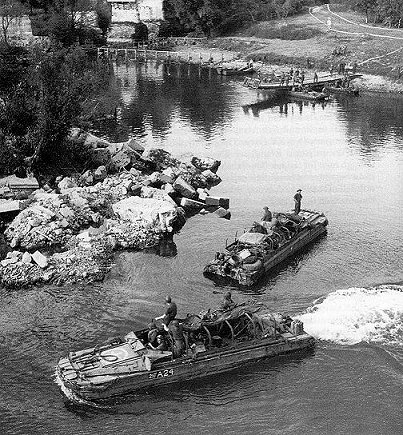
DUKWs at Veronnet (Worcestershire Regt.)
Last weekend I had the pleasure of finally sitting down to a game of ASL (two, as it turned out) with a chap Victory Comics in Falls Church, a location new to me that features a large space (including a good many gaming tables), a huge comics selection, and a nice range of boardgames. We played a scenario from a new module that's being playtested for Bounding Fire Productions, a Historical Advanced Squad Leader (HASL) treatment of Operation Neptune. No, not the D-Day landings, but the 43rd Wessex Division's opposed crossing of the Seine River in August 1944. This scenario features an infantry company attempting to cross the Seine in boats with covering fire from tanks and machine-guns. You'll have to wait for the module for details, but suffice to say this scenario will be a nail-biter with some toys to please all types.
I've been corresponding with for many years. We played at

Liberty or Death (GMT Games)
Tonight I'm hoping to inveigle one of my chums into trying out GMT Games' new American Revolution game Liberty or Death. It's an application of the highly popular COIN (counterinsurgency) game system (devised by designer Volko Ruhnke) to the political-military conflict between Britain and her American colonies. Like most COIN designs, it's a four-player game that can be played solitaire or with fewer than four players either by players controlling two aligned (but competing) factions or by the use of well designed paper-based artificial intelligence players. The third and fourth positions in this conflict are allotted to the Native American nations (as allies of the British) and to France (as an ally of the Americans), both of which have their own agendas and their own victory conditions different to those of their allies. Combine a successful basic system, designer knowledgeable in his topic and skillful at adapting the system to purpose, and gorgeous artwork, and you've got what I anticipate to be an excellent game. I've been reading progress reports on this title for some time, and I'm quite chuffed to be able to finally put it on the table.

1866 (Mediaeval Miscellanea)
And this weekend I'll have the pleasure of helping to playtest a scenario for the highly enjoyable 1866 rules from Bruce Weigle. This will be his full-bore treatment of the crucial battle of Königgrätz (aka Sadowa) from the Austro-Prussian War of 1866. I recently got hold of a copy of Avalanche Games' Battles of 1866: Frontier Battles, which includes several engagements from this war but not the conclusive engagement itself (they keep promising to release it as an add-on, but it seems that time has passed that idea by). But I've played one or two battles from this curious war before using Bruce's rules, and I'm looking forward to the mammoth encounter. The 1866 rulebook has Koniggratz among its scenarios, but done as two different engagements. This will be a huge game covering the entire battle.

Reading up on it, I'm guessing that the Austrian may have a chance to overcome their deficiencies of tactics and technology (better-ranged weapons, but slower-firing ones) as the battle kicks off with the Austrians outnumbering the Prussians. They had better take advantage of the opening, however, as the arrival of the Prussian Second Army under Crown Prince Friedrich (son in law of Britain's Queen Victoria and father of the future "Kaiser Bill", Wilhelm II) will seal the Austrian's fate, as it will complete their encirclement and push the odds strongly in the Prussians' favour. We shall see!

Saturday, September 6, 2014

More COIN in my pocket

That's got to be a new record--my copy of Fire In The Lake (FITL) hasn't arrived yet, and I've already played it once.

My friends Eric and Amir came over, with Eric's copy of the latest Volko Ruhnke Counterinsurgency (COIN) title, FITL, which covers the US war in Vietnam. We walked through the programmed demonstration in the play book to learn the mechanics, they played on from there.

We had a few questions, but between the clarity of the rules and my experience with the previous COIN title Cuba Libre, we didn't find it too difficult to play. We had to stop before we were entirely played out, but the next card up would have provided a break to check victory conditions, and Eric (playing with both the VC and NVA hats on) would have won as the VC.

We all agreed that we enjoy the system and will enjoy playing both this instance and others in the future.


Friday, November 1, 2013

recent boardgaming shenanigans

I've been very fortunate in getting to do a fair amount of gaming of late. I'll start off the catalog by mentioning some of the boardgames involved, then move to miniature gaming.

At the Gates of Loyang is a favourite option when I go to game with my ex Chris and her wife Mel. Though we've played Troyes a good deal too in the recent past, and we've also included Glory to Rome and Alhambra (especially appealing to them since they've had the opportunity to explore the original), Loyang has been our most common go-to option of late, eclipsing even Agricola.

Interestingly, though, Loyang has started presenting a bit of a dilemma. The grrlz tend rather to frown on overly defensive play ("I'll just consume all these resources, even though I don't need them, so they won't be available to other players"). But after repeated playings of Loyang, they're feeling that maybe it doesn't have enough player interaction. Given that one does compete for cards in the marketplace at the beginning of the turn, and that various helpers allow you to use other players' assets during play, this suggests that someone is looking for a bit more defensive play, whether they want to think of it that way or not.

Offensive-defensive play is key to Lost Cities, which Mel and I had two games of the other day after we all had Sunday brunch and Chris then had to go off to work. A good part of the play of the game is deciding which cards to hold onto, even if you can't use them, because you don't want to give the other player the opportunity to play them as part of one of their expeditions. It's one of two major dilemmas of the game, the other being "when do you decide that you have enough cards of an expedition to risk starting it?" Do you wait until you're sure you will break even? By that time it may be too late...

My Wednesday nights are generally spent with my friends Bryan and Peter. Bryan has been known to describe our get-togethers as "We have some beers and talk and Jan tries to get us to play a game." That's a fair description. :-) They've been fairly obliging lately; we've added three games to our repertoire: Cuba Libre, Downfall of Pompeii, and Byzantium.

Cuba Libre is one of the growing stable of COIN (counterinsurgency) wargames masterminded by Volko Ruhnke and published by GMT Games. Smaller in size and scope then the first title in the series (Andean Abyss, centered on the insurgency and drug war in Colombia), CL is described admiringly by one reviewer as "a knife fight in a phonebooth". Four factions (the standard model for the COIN series) fight over the Cuba of 1957-58. The government player attempts to maintain the stranglehold of the island's corrupt oligarchs, while two rebel movements, the Revolutionary Directorate and the 26th July Movement attempt to overthrow the regime. The fourth player, the Syndicate, nominally supports the government but seeks primarily to make money through the growth of its casino chain and the corrupt control of the island's primary economic resources.

Bryan, ever the staunch supporter of law and order, took the Government side; red revolutionary that I am, I took the 26 July; and Peter, showing an unexpected mercenary, chose the Syndicate. We played most of the way through the deck, with the Government and the Syndicate running neck and neck for the latter portion of the game. I made a sad mess of the revolution, my pitch partly queered by a powerful Directory performance (the game includes a very effective text-based AI for each of the four players, allowing it to be anything from a four-player match to a solitaire game). I'll consult my notes, but my memory is that Peter pipped Bryan at the post. I'm hoping we get another chance to play this again soon, maybe with a fourth human player to round it out. I also have Andean Abyss and A Distant Plain, the third COIN game, which covers the US war in Afghanistan, and I hope I can get the guys to give those a try too.

But the next week we had a go at a new game I had picked up, Downfall of Pompeii. This had gotten fairly good reviews on BoardgameGeek, so I hazarded purchasing it and was not disappointed. The Boyyz and I played it three times in an evening, and I later played it twice in an evening with the Grrlz. It plays in two stages: in the first, players fill the city with their meeples (and their families who, oddly, come flocking into the city once there's news that the volcano might explode). Then in the second phase players try to save their meeples by rushing as many of them as possible back out of the city again, as the pyroclastic flows engulf whole neighbourhoods, burying unlucky meeples or cutting them off from the city gates.

We enjoyed this quite a bit on both occasions. It can be tricky trying to place your people so as to give them the best chance of escape but, at the same time, clustering them as much as possible (since this increases the number of their country cousins who are added in the "relatives" round).

Then, just this week, the Boyyz and I tried out Byzantium. I've had this game for years, but only played it once before, some time ago. It's a curious game in that, while its focus is the struggle between the Byzantine Empire and the rising Islamic caliphate, the players don't take sides between the two. Each player controls an Arab army and a Byzantine one and tries as best as possible to balance the victory points s/he earns for each. Each turn, the players alternate taking actions (move and attack, tax, reinforce armies, or a list of more specialized actions) until all have exhausted their supply of action markers (or choose to stop). Income is then collected and armies paid for, then a new turn is started. After three turns, the game ends and the player with the highest combined score for both Arabs and Byzantines is the winner. A player can play one side (Byzantine or Arab) all out, but if one VP total is less than half the other, one only gets whichever one is larger.

We played this through once, and the scores were very close. One gets VP for claiming Byzantine or Arab cities at the beginning of the game, for capturing them from other players during the game, for spending money building mosques or churches, and for cities that you control at the end of the game. Battles between armies are bloody but sieges are relatively painless, so there's a definite advantage to getting one of your armies where opposing ones are not and snapping up lots of their cities. Of course, if your army is off doing that, the other players' armies might be doing the same...

In addition to all of these multiplayer games, I've had the opportunity to solo-play two other games. I'll cover those in my next post. Then I should have a shout about recent miniatures gaming. And I'll try to provide some photos of all of these endeavours once I have my camera photos downloaded, uploaded, and organized.