Background image is Les Dernières Cartouches (The Last Cartridges) by Alphonse de Neuville
Showing posts with label Rev War biographies. Show all posts

Friday, September 9, 2016

Project 1777: The Second Pennsylvania Brigade and Proctor's Artillery

John Phillip DeHaas by CW Peale (Wikimedia)
2nd Pennsylvania Brigade

In the (never explained) absence of Dutchman-turned-Pennsylvanian Brigadier General John Phillip DeHaas (formerly of the 2nd Pennsylvania), Colonel Richard Humpton commanded the division's second brigade. A Yorkshireman who had held a King's commission in the British army and fought in France during the Seven Years' War, Humpton had settled in Pennsylvania after that conflict. He was commissioned as a lieutenant colonel, then colonel, in the Pennsylvania Flying Camp in 1776, then given command of the 11th Pennsylvania Regiment in October of 1776 and commanded it through the battle of Trenton.

Humpton commanded the 2nd Brigade in the 1777 campaign, fighting at Brandywine, Paoli, and Germantown. After the battle of Monmouth, the 11th Pennsylvania was merged into the 10th, Humpton taking command of the combined regiment. Following the Pennsylvania Line mutiny of 1781, the 10th was dissolved, and Humpton took command of the 6th Regiment, then headed the 2nd Regiment before he retired in 1783 with the brevet rank of brigadier general.

Humpton became the center of a bitter dispute with Anthony Wayne following the battle of Paoli. Humpton maintained he had been warned of the attack at Paoli by a Scots deserter and that he had attempted to convey the news to Wayne, whom he said mocked him and refused to believe an attack was imminent. Wayne denied any such discussion had taken place and blamed Humpton for reacting slowly and ineffectively with his brigade when the British attacked, forcing Wayne (who claimed to have been alert and prepared to fight) to fall back to avoid encirclement. A court martial eventually acquitted Wayne unreservedly, though it cast no direct aspersion on Humpton.

4th Pennsylvania Regiment
Authorized in late 1775 and raised early in 1776 as the 3rd Pennsylvania Battalion, the unit saw action in the New York campaign. The battalion was detached from the Main Army to help build fortifications around New York and so missed the battle of Long Island. The unit rejoined the Main Army and served in the rest of the battles of the New York campaign, eventually returning to the fortifications it had helped build. A large part of the unit was captured when Fort Washington surrendered to the British. The remainder was reorganized as the 4th Pennsylvania Regiment in January 1777. As such, it fought at Brandywine, Paoli, and Germantown in 1777 and at Monmouth in 1778, and it took part in the genocidal campaign against the Iroquois ordered by Washington and carried out by Major General John Sullivan in 1779.

Of interest, Lambert Cadwalader, a Philadelphia merchant and a member of the Provincial Assembly, served as the lieutenant colonel of the 3rd Battalion and was taken captive at Fort Washington. He was released on parole, and he was appointed colonel and commander of the now renamed 4th Pennsylvania. But as he had not been exchanged (Washington having prohibited the release of British field officers held as prisoners of war), his scruples prevented him from accepting that commission, and he eventually resigned from the army and returned to politics in Pennsylvania. He was elected to the Continental Congress in 1784. In his absence, the regiment seems to have been commanded by by Lt. Col. William Butler, one of five brothers, first-generation immigrants from Ireland, who fought in the Pennsylvania Line during the Revolution.

Deserters from the regiment captured in 1776 suggest that the regiment at that time was uniformed in brown regimentals faced white, buckskin breeches, and hats bound with white tape. A deserter captured the following year wore a hunting shirt, linen trousers, and woolen stockings (no colours given) and had no shoes (!)

5th Pennsylvania Regiment
This regiment originally raised at the 4th Pennsylvania Battalion. It served in Canada and in the defense of Lake Champlain. Moved back to the Main Army from the Canadian and Northern Departments, it was reorganized as the 5th Pennsylvania Regiment. It had been commanded by Anthony Wayne; when he was promoted to brigadier general, command of the 5th was assigned to Colonel Francis Johnson, a friend of Wayne's who had been the 4th Battalion's lieutenant colonel. Johnson commanded the 5th for the rest of the war. Under Johnson, the regiment fought at Brandywine, Paoli, and Germantown. It later fought at Monmouth and Springfield in New Jersey and at Green Spring and Yorktown in Virginia.

The 4th Battalion had been uniformed in blue coats faced white. More coats were issued to the 5th in 1777 by the Clothier General, but I have not been able to ascertain what colour(s) they were. Deserter descriptions from 1777 include a rainbow of clothing, including blue and white or brown and white regimentals, brown or "light-colured" coats, grey or green or blue jackets, purple or yellow hunting shirts, and one blanket coat!

Col. Daniel Brodhead by CW Peale (Robert Cairns)
8th Pennsylvania Regiment
Originally raised as Mackay's Battalion (after its colonel, Aeneas Mackay), this formation was embodied in the far western counties of Pennsylvania as a troop for the defense of the frontier. In January 1777, it was renamed the 8th Pennsylvania Regiment and summoned to join the Main Army in New Jersey. The regiment, lacking tents and even coats for some of its men, suffered considerable loss from its mid-winter march across the state; 50 men died, including the colonel and lieutenant colonel, and many more became ill. After some recovery, the unit took part in the Forage War, including the battle of Spanktown. Colonel Daniel Broadhead transferred from the 4th to command the 8th, while Maj. Richard Butler (another of the "fighting Butlers") was promoted to serve as lieutenant colonel.

The 8th was part of the small garrison of Bound Brook that was severely handled by the British attack. Although most of the regiment got away, the experience, after the grueling trek of January and the loss of their senior officers, put the regiment into what General Washington referred to in a letter as a "distracted State"; disciplinary actions were taken, and an inquiry into the state of the unit was undertaken (conclusions unknown).

In June, the regiment lost its new lieutenant colonel, a captain, and 140 men, who were sent to join Morgan's Rifle Corps in the Northern Department. The hard-luck 8th next participated in Wayne's defeat at Brandywine and at the disaster of Paoli. It was then part of the initially successful assault on the British light infantry at Germantown, helping to chase off the lights and plunder their camp; but circumstances of that confused battle led to the 8th appearing unexpectedly in front of Sullivan's division, which promptly began shooting into the mass of horrified Pennsylvanians.

In 1778, things were not much better, with the 8th dispatched back to the Pennsylvania frontier, where it was involved in Brigadier General Lachlan McIntosh's abortive attempt to invade the Ohio Country. In 1779, the regiment took part in an secondary operation of Sullivan's campaign against the Iroquois. Finally, in 1781 the regiment took part in the Pennsylvania Line mutiny and was disbanded, with its remaining men being consolidated into the new 2nd Pennsylvania.

Deserters after Bound Brook were reported wearing, variously, brown coats, blue coats, and hunting shirts, though none of these are described in terms that convince the reader they were military issue. It may well be that there had been no issue of uniforms to the regiment even as late as that. A portrait of Col. Brodhead from the winter of 1777/1778 shows him in a regimental coat of blue faced red; if the regiment eventually wore these colours, it would be in keeping with the norm for much of the Pennsylvania Line.

11th Pennsylvania Regiment
Humpton's lieutenant colonel, Francis Gurney, presumably commanded the regiment in his absence. The 11th had been raised in September 1776 and had served at Assunpink Creek and at Princeton in that year. In 1777, the regiment fought at Brandywine, Paoli, and Germantown. It was present but saw no action at Whitemarsh. In 1778, it fought at Monmouth; later that year it was consolidated into the 10th Pennsylvania.

The 11th wore blue coats faced red. 

Proctor's Artillery
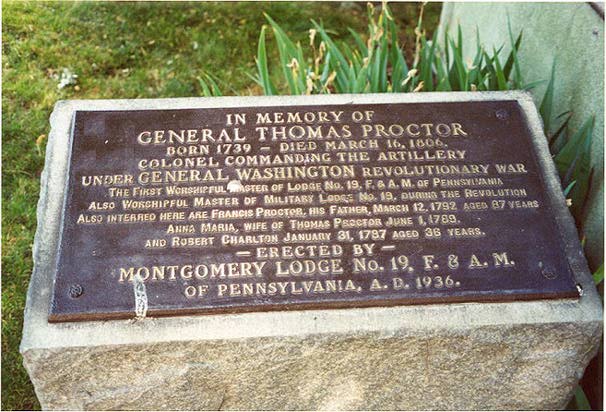
Marker at St. Paul's Episcopal Church, Philadelphia
(US Gen Web Archives)
Thomas Proctor emigrated from Ireland to the Americas with his parents in the 1740s or 1750s and proceeded to establish himself as a carpenter in western Pennsylvania and later in the Philadelphia area. In 1775, he was commissioned as a captain by the Pennsylvania Council of Safety and raised the state's first company of artillery. In August 1776, his grew to a battalion, with Proctor, now a major, in command. Over the winter of 1776/1777, Proctor took temporary command of the entire Continental artillery establishment while Knox was on leave from the army. In the spring, the Pennsylvania Artillery Battalion was expanded to a regiment (Proctor was promoted to colonel) and then transferred to Continental service as Proctor's Continental Artillery Regiment.

As the Pennsylvania Artillery Battalion, Proctor's men fought bravely at Trenton and at the battle of the Assunpink. In 1777, a detachment from Proctor's regiment lost its guns at Bound Brook, and another detachment lost some or all of its pieces when Knyphausen's division stormed across Chadd's Ford at the battle of Brandywine. Now officially the Proctor's Continental Artillery Regiment, Proctor's men fought at Germantown, where it unsuccessfully bombarded the Chew House. The regiment served at the battle of Monmouth, where it may have provided the source for the legend of Molly Pitcher. In 1779, the regiment acquired a number (the 4th Continentals) and went as part of Sullivan's Expedition. Returning to the main army, the regiment fought in smaller battles around New York. In 1781, it went south with Wayne as part of his command in Virginia, but by this time Proctor had left the regiment, and the army, resigning over a dispute with the Pennsylvania government over who could issue commissions to command the regiment's companies. The 4th served at the siege f Yorktown and was finally dissolved in 1783.

The uniform of Proctor's regiment was consistently blue regimentals with red facings. Apparently when some of the army's artillery went to black coats faced red, Proctor refused; the change never took hold fully, and the army switched back later to blue faced red. Proctor's regiment included a band of music (dressed in red coats, given a request from Proctor to the Clothier General) at one point, who played for the commander in chief's birthday celebration at Valley Forge in 1778.

(Note: military bands, often civilian contractors paid by the regimental commander rather than serving soldiers, were distinct from the "field music"--fifers and drummers--who signaled orders and provided drill cadences. A regimental band of music generally consisted of hautbois (oboes), bassoons, serpents, and/or trumpets and played for ceremonial and social functions.)

For a look at some Continental Artillery dressed as Proctor's probably were, see Giles Allison's American Artillery (5) post. For his version of Molly Pitcher, see American Artillery (3).

Wednesday, September 7, 2016

Project 1777: Lincoln, Wayne, and the Pennsylvanians

The first engagement of the 1777 Philadelphia campaign, to my mind, was the British attack on Bound Brook. It served as the transition between the winter's Forage War, the petite guerre of outposts and ambuscades, and the opening of General Lord Howe's field campaign, the attempt to draw General George Washington and the American army into an open battle.

Ewald's map of the engagement at Bound Brook (Wikimedia)
Bound Brook also served as Major General Benjamin Lincoln's first and last engagement as commander of the 4th Division of the Main Army. Lincoln had taken command of the division shortly after receiving his major general's commission from Congress in February 1777. Only one regiment (the 8th Pennsylvania) from his division fought at Bound Brook, along with a few Pennsylvania and New Jersey militia units and a Pennsylvania artillery company, Proctor's.  In July, three months after the brief skirmish on the Raritan, Lincoln was riding north, along with Major General Benedict Arnold and Colonel Daniel Morgan--two tough and unconventional fighters--to assist in the defense of the Northern Department. General George Washington ordered Brigadier General Anthony Wayne to take charge of the division in Lincoln's absence.

Wayne and horse by Alonzo Chappel (Wikimedia)
Anthony Wayne

Wayne was the son and grandson of immigrants. His grandfather, Captain Anthony Wayne, served in the Anglo-Dutch army of William of Orange against the Jacobites in 1690 and later brought his Dutch wife and young son Isaac to Pennsylvania from Ireland in 1699. Isaac, our Anthony's father, served as an officer in the Pennsylvania Military Association (the volunteer defense force that protected the colony during the French and Indian War because the Quaker-owned colony refused to establish a militia) and in due course took over running the family estate as well as the tanning business his father had established, which had grown to be the largest in Pennsylvania. Young Anthony sought a more exciting life and, after studying at his uncle's private academy and the College of Pennsylvania, he became a surveyor, working for Benjamin Franklin and other Philadelphia land speculators. Chester County electors sent him to the Provincial Assembly in 1774, and he joined many of the revolutionary organizations (the Provincial Committee of Safety, the Provincial Convention, and the Committee of Correspondence) that sprang up as war came closer.

In 1776, Wayne was appointed colonel of the 4th Pennsylvania Battalion (later the 5th Pennsylvania Regiment). He commanded the regiment through an ignominious campaign in Canada and was left in command of Fort Ticonderoga when senior officers abandoned it for the warmer and better-supplied surroundings of the Main Army and Congress. In February 1777, Wayne was among those promoted to brigadier general, and he was summoned south to take up command of the 1st Pennsylvania Brigade.

"Dandy Wayne" (he took pleasure in dressing well) studied military arts and sciences as many Americans did, by reading everything and anything of a professional military nature that he could get his hands on. He swore like a sailor, drove his men hard, but asked nothing from them (like bravery or self-discipline) that he didn't expect from himself. He assumed a bold manner; one fellow Pennsylvania officer compared him to the French Marshal-General the Duc de Villars, who was as renowned for his braggadocio as for his bravery. While fierce and boastful, Wayne was calm, almost ice-cold in action, so much so that later in the war Washington selected him on several occasions for special commands that required a brave but cool-headed officer, such as the Corps of Light Infantry's attack on Stony Point in 1779.

1st Pennsylvania Regt. colour (http://www.vssr.org)

The Pennsylvania Division

As the 1777 campaign opened, the 4th or Pennsylvania Division of the Main Army consisted of two brigades, one of five regiments and one of four. Although the artillery doctrine devised by Washington and the army's artillery chief, Brigadier General Henry Knox, called for a company of two to four guns to support each brigade, these companies were not formally allocated as part of the divisional organization. As brigades were formed mostly from troops from one state or region, the army tried to arrange that supporting artillery would come from the same state or region. In 1777, the Pennsylvania Division was often supported by gunners from the command of the Irishman-turned-Pennsylvanian Thomas Proctor.

The First Pennsylvania Brigade

With the departure of Lincoln and Wayne's shift to divisional command (though it came with no promotion--Wayne was not commissioned as a major general until 1783), the 1st Pennsylvania Brigade was commanded by Colonel Thomas Hartley.

Hartley was an attorney who practiced in York and Philadelphia and who served in Pennsylvania's Provincial Convention in 1775. He held commissions first as lieutenant and then as lieutenant colonel in the Associators. He the commanded the 6th Pennsylvania Battalion as lieutenant colonel during its service in Canada in 1776. In 1777 Congress authorized Washington to raise several additional regiments to supplement those allocated to specific states. With lobbying from Richard Henry Lee, Hartley obtained the commission to raise one of these and spent the spring raising it and attending to other matters (for an entertaining correspondence between Hartley and an increasingly annoyed Washington, see this page at the National Archives).

1st Pennsylvania Regiment
One of the first units raised in the war, this regiment started out as Thompson's Rifle Battalion or the Pennsylvania Rifle Regiment. Several companies were sent on Arnold's expedition to Canada, while the remainder served in the siege of Boston. After the siege ended, and with Col. William Thompson promoted to brigadier general, the regiment became the 1st Continental Regiment, under the command of Lt. Col., later Col. Edward Hand. A new name change saw the regiment re-titled the 1st Pennsylvania Regiment, and as such it fought at Long Island, providing the army's rearguard in that action.It fought at Harlem Heights and White Plains. When Washington led the army across the Delaware to attack Trenton, the 1st Pennsylvania led the way in the battles of Trenton, Assunpink Creek, and Princeton.

In early 1777, Hand too was promoted to brigade command and Col. James Chambers took command of the 1st. Under Chambers' command the regiment fought at Brandywine, Paoli, and Germantown and was prepared to engage at White Marsh. In 1778, the regiment exchanged its rifles for muskets and bayonets and as regular infantry fought at the battle of Monmouth. The regiment's light company took part in the storming of Stony Point under Anthony Wayne.

In 1777, the uniform of the 1st Pennsylvania was brown regimentals faced green, but when in the field the unit more often wore hunting shirts and linen or deerskin overalls. In 1776, Col. Hand had ordered material for shirts that were intended to be green, trimmed in red. Similar outfits were often made of brown, black, white, or "drab" cloth. Another account suggests that the 1st received green regimentals (possibly faced red) in the winter of 1776 and green hunting shirts with buckskin breeches. Though he didn't paint them specifically to be the 1st Continental/1st Penna., Giles Allison features some well painted American riflemen on his Tarleton's Quarter blog here and also here.

2nd Pennsylvania Regiment
Originally formed in 1775 as the 1st Pennsylvania Battalion, this unit served in the invasion of and then retreat from Canada and the defense of Lake Champlain. IN 1776 it was reorganized as the 2nd Pennsylvania Regiment and fought at Trenton and Princeton. Its colonel, John Phillip DeHaas, was promoted to brigadier general. A replacement colonel was appointed but did not take command of the regiment before he resigned in the summer of 1777. In the meantime, the regiment was commanded by Major William Williams.

Some sources suggest the regiment took part in the action at Bound Brook. It certainly fought at Brandywine, Paoli, and Germantown (where Maj. Williams was captured). It was present at Whitemarsh, fought at Monmouth, and served throughout the rest of the war.

In 1777, the uniform of the 2nd Pennsylvania was brown regimentals faced green. For some handsomely painted 2nd PAs, see Giles Allison's Tarleton's Quarter blogpost here.

Division flag of the 7th Pennsylvania (www.vssr.org)
7th Pennsylvania Regiment
Commanded in 1777 by Colonel David Geier. The 7th Pennsylvania was raised in 1776 as the 6th Pennsylvania Battalion, which served in Canada and in the defense of Lake Champlain in that year. In January 1777, it was reorganized as the 7th, in which capacity it served in the campaigns in northern New Jersey, in defense of Philadelphia, and in 1778 at the battle of Monmouth.

In 1776, the 6th Battalion may have worn blue regimentals faced red, and it appears that the 7th Pennsylvania retained these. Another possibility is that they wore brown coats faced red.

10th Pennsylvania Regiment
Originally raised by Colonel Adam Penrose, who led it in combat at Princeton, the 10th was commanded in 1777 by Lieutenant Colonel Adam Hubley. It fought at Brandywine, Paoli, and Germantown and the next year at Monmouth. When the 11th was combined into the 10th in 1778, Col. Richard Humpton took command of the consolidated unit.

I have not been able to find a reliable indication of the 10th's uniforms, so one can only made educated guesses. The uniforms adopted by the Military Association in 1775 had been almost all variations on brown regimental coats, while the two Pennsylvania state units (a rifle regiment and a musketry battalion) had worn blue coats faced white. The Pennsylvania Continental regiments of 1776 had been uniformed in blue faced red, blue faced white, brown faced green, and brown faced red. When officers bought cloth for additional coats in late 1777 the majority were blue faced red, with smaller quantities of blue faced white, brown faced white, and brown faced green.

Hartley's Additional Continental Regiment
Hartley being in command of the brigade, his regiment was commanded by Lieutenant Colonel Morgan Connor. Hartley had recruited Connor (or Conner or Conneer or O'Connor, spellings varied) from the 1st Pennsylvania Regiment, which he had joined in 1775, serving at Boston and later at Trenton, where he was wounded. An Irish Roman Catholic, Connor had also served twice as a staff officer in South Carolina and would go on to command other Pennsylvania regiments before becoming the Continental Army's adjutant general. He received sick leave in 1779 and was lost at sea when traveling to the West Indies for a rest cure.

Recruited from Pennsylvania, Maryland, and Delaware, the regiment was barely made up in time to join the spring 1777 campaign. It fought at Brandywine, Paoli, and Germantown during that year. In 1778, it was moved to the Pennsylvania frontier to fight Indians, and in 1779 it joined several other regiments in being subsumed into the "new" 11th Pennsylvania.

In 1777, Hartley's Additional Regiment was uniformed in blue regimental coats faced white.You can see some well-painted Hartley's here.

Next Post: the Second Pennsylvania Brigade and Proctor's Artillery

Saturday, April 30, 2016

Project 1777: the Battle of Short Hills

Apologies, faithful readers! Life has kept me busy with family matters and projects at work that have eaten up my time and energy. Weekend time to devote to work on Project 1777 has been sparse. I still mean to get a playing or two of some of these early skirmishes under my belt, both to re-familiarize myself and some of my comrades with the game system and to test out some of my ratings for the units involved.

Until I can make that happen, though, I have another battle synopsis to share with you. This engagement, though still a bit one-sided historically, could be touched up to make an interesting game a little more easily than Bound Brook.

Nathanael Greene (Wikipedia)
Back to 1777

When we last left General Sir William Howe, his ploy to draw the American Army into a trap at their forward post of Bound Brook had failed. Lt. Gen. Lord Cornwallis had surrounded and attacked the American post, chasing off Maj. Gen. Benjamin Lincoln in his nightshirt (possibly even without that!) and capturing several cannon. But the Americans' nearest supports, Maj. Gen. Nathanael Greene's division, had not arrived to reinforce Lincoln until after the British forces had left. Greene harassed the rearguard of the retreating British, then ensconced himself in Bound Brook.

However, after Greene had waited several weeks to see what else might develop, Lt. Gen. George Washington had pulled Greene's division back, leaving Bound Brook to lie in the debatable zone between the two armies. Bound Brook was too far from the main American position at Morristown to be supported adequately; it was too vulnerable to sudden attack to be a suitable forward base.

Nevertheless, Washington gave Howe some room to hope that the rebel commander could still be drawn out of his fastness in the Watchung Mountains. On May 28th, two days after Greene was recalled from Bound Brook, the American army moved from its winter camp at Morristown to Middlebrook, still in the mountains but closer to the British advanced base at (New) Brunswick.

A Cunning Plan...Foiled

In June, Howe feinted, trying again to bring the Americans down out of the mountains and onto the plains of New Jersey where he hoped to defeat them in detail. Attempting to convince the Americans that he was marching toward the Delaware River and Philadelphia, the American capitol, Howe moved the main British army out of New York into New Jersey and settled for several days at Somerset Court House, south of Brunswick. But spies had told the Americans that the British bridging train, without which they could not cross the Delaware River, had remained in New York. Other supplies had also been left behind, meaning that the British could not stay in the field for long.Washington did not bite on Howe's proffered bait.

William Alexander, Lord Stirling (Hidden New Jersey)
Instead, Washington waited, and when Howe began moving back towards New York, the Americans came down from the mountains into the foothills, shadowing the King's army as it moved back to its base and picking off any stragglers who fell behind on the march. With his main army at the delightfully named Quibbletown, Washington sent an advanced guard under Maj. Gen. William Alexander to harass the British rearguard, much as Greene had chivvied Cornwallis's men after Bound Brook.

Alexander, sometimes known as Lord Stirling because he claimed to have inherited that Scottish title, had a reputation for bravery forged at the battle of Long Island the previous summer. Holding the right of the American line in that battle, Stirling had eventually been surrounded and his command forced to flee or surrender. His force had taken heavy losses, but through its sacrifice it had prevented the encirclement and capture of the entire American army. Alexander was later exchanged for Monfort Browne, the Governor of the Bahamas, who had been captured during an American raid on the islands in March of 1776. After returning to the army, Alexander commanded a brigade under Greene in the winter 1776/1777 campaign, leading the center of the American line at the battle of Trenton.

Now he sought to inflict some losses on the British rear guard as their army retreated to Perth Amboy, from there presumably to return to New York.

Barking at the Heels of the British Army

Howe determined to deal a sharp blow to Alexander's force and, as always, hoped that in the process he could draw the American field army into a decisive battle. Cornwallis, Howe's most aggressive general officer, received command of a strike force designed for speed and power. Cornwallis set off an hour after midnight with a task force of light dragoons, mounted and foot jaegers, the Queen's Rangers, a unit of Guards, and battalions of British and German grenadiers. Howe and Maj. Gen. John Vaughn followed with more jaegers, more British grenadiers, and a force of British light infantry.

A Hessian officer's map of the battle of Short Hills (Wikipedia)
As shown in the map drawn by Friedrich von Wangenheim, a Hessian mounted jaeger officer, Cornwallis' force and that under Howe advanced on parallel road, hunting for Alexander's division. Cornwallis made contact first, his jaegers coming into contact with American riflemen of Morgan's Corps just after dawn. The riflemen fought hard, not falling back until charged with the bayonet. As they were pressed, the riflemen fell back on Ottendorf's Corps, an independent light infantry force commanded by Lt. Col. Charles Armand Tuffin in the absence of its titular leader, and a body of New Jersey infantry--either militia or Continentals from Brig. Gen. William Maxwell's brigade--backed up by several artillery pieces. These supports helped stiffen the riflemen's resistance, but as more troops were deployed from the British column to the attack, the Americans were forced further back.

A Bitter Fight

Charles Armand Tuffin, Marquis de la Rouerie (Wikipedia)
Alexander had selected a defensive position on a ridge running perpendicular to the road. There he placed the main strength of his force, the remainder of Maxwell's brigade and a brigade of Pennsylvanians under Brig. Gen. Thomas Conway. Cornwallis tried to outflank this position by sending a battalion of Hessian grenadiers in a wide sweep around the Americans' left flank, but this was stalled by a battery of four French artillery pieces, carefully concealed in enfilade on a wooded hillside. One Guards officer foolishly attempted to capture the battery single-handed and was shot down at Alexander's direction. But a force of less than 2,000 men, even possessed of good defensive terrain, cannot hold against nearly 4,000 indefinitely. Eventually the pressure of the British attack forced Alexander's troops backwards, through the town of Westfield and over another line of wooded hills to the edge of the Watchung Mountains. The British, exhausted by nearly six solid hours of fighting, set to plundering Westfield. Joined by Howe's column, the expedition camped in area around the town that night and then marched back towards Staten Island the next day by way of Rahway.

Howe had again failed to draw out Washington's army, and he had missed even the prize of surrounding and capturing Alexander's division, though the British did take three of Alexander's four French guns back to New York with them. One amateur historian alleges that Washington heard the initial gunfire between the jaegers and Morgan's riflemen ten or fifteen miles away in Quibbletown and that the terrified commander immediately ordered his main army to begin fleeing back into the Newark Mountains.This seems unlikely, as does the claim that Alexander's fight at Short Hills was a brilliant strategic victory, allowing the main army time to escape a British trap. The trap had been set for Alexander, who did deftly avoid it, but Howe had not expected, when he set out in the dead of night, to encircle the American main army, only its somewhat dangerously advanced guard. One account even goes so far as to suggest that Alexander deliberately ignored an order from Washington to fall back from contact with the British main force; if that is true, Alexander was lucky to keep his command, escape or no.

A Tentative Order of Battle

My preliminary order of battle for this engagement (drawn from returns and assuming that Howe's column proves, as it did historically, to be too far away to support Cornwallis) looks something like this, much smaller than some of the fanciful and inflated numbers of some modern accounts. (Note: The larger number next to a unit is its historical strength, or my best approximation of it. The number in brackets is the number of stands used in the game to represent it: four-figure stands for infantry, two-figure stands for cavalry.)

Major General William Alexander, Lord Stirling (1,800 of all arms)

Lieutenant Colonel Charles Armand Tuffin
Ottendorf's Independent Corps (100 [2]): Line, Trained, Poor, Average
Morgan's Provisional Rifle Corps, detachment (100 [2]): Elite, Crack, Average, Excellent

Brigadier General William Maxwell
1st & 2nd New Jersey Continentals (300 [4]): Line, Trained, Average, Average
3rd & 4th New Jersey Continentals (300 [4]): Line, Trained, Average, Average
Spencer's Additional Continental Regiment (200 [3]): Line, Trained, Poor, Average
New Jersey state artillery (two sections of two four-pounders, 100): Line, Trained, Average, Average

Brigadier General Thomas Conway
3rd & 6th Pennsylvania Continentals (300 [4]): Line, Trained, Poor, Average
9th & 12th Pennsylvania Continentals (300 [4]): Line, Trained, Poor, Average
Pennsylvania state artillery (two sections of two four-pounders, 100) Line, Trained, Average, Average

Lieutenant General Charles, Lord Cornwallis (3,600 of all arms)

Captain James Weymss
Queen's Rangers (400 in two wings of [4] each): Line, Veteran, Average, Good
Ferguson's Rifle Corps (120 [2]): Line, Trained, Average, Excellent
16th Light Dragoons (300 in three squadrons of [1] each): Line, Veteran, Average, Poor 
Royal Artillery (two sections of two six-pounder guns, 100): Elite, Veteran, Average, Good

Brigadier General Carl von Donop
Hesse-Kassel Feld Jaeger Korps, foot companies (100 [2]): Elite, Crack, Good, Excellent
Hesse-Kassel Feld Jaeger Korps, mounted company (80 [1]): Elite, Crack, Good, Excellent
Linsing Grenadier Battalion (430[5]): Elite, Veteran, Good, Poor
Minningerode Grenadier Battalion (430[5]): Elite, Veteran, Good, Poor
Lengerke Grenadier Battalion (440[5]): Elite, Veteran, Good, Poor
Hessian artillery (three sections of two four-pounder guns, 150): Line, Veteran, Average, Good

Lieutenant Colonel Sir George Osborn
1st Foot Guard Battalion (450 in two wings of [5]): Elite, Veteran, Good, Average
2nd Grenadier Battalion (500 in two wings of [5]): Elite, Crack, Good, Average
Royal Artillery (two sections of two three-pounder guns, 100): Elite, Veteran, Average, Good