|
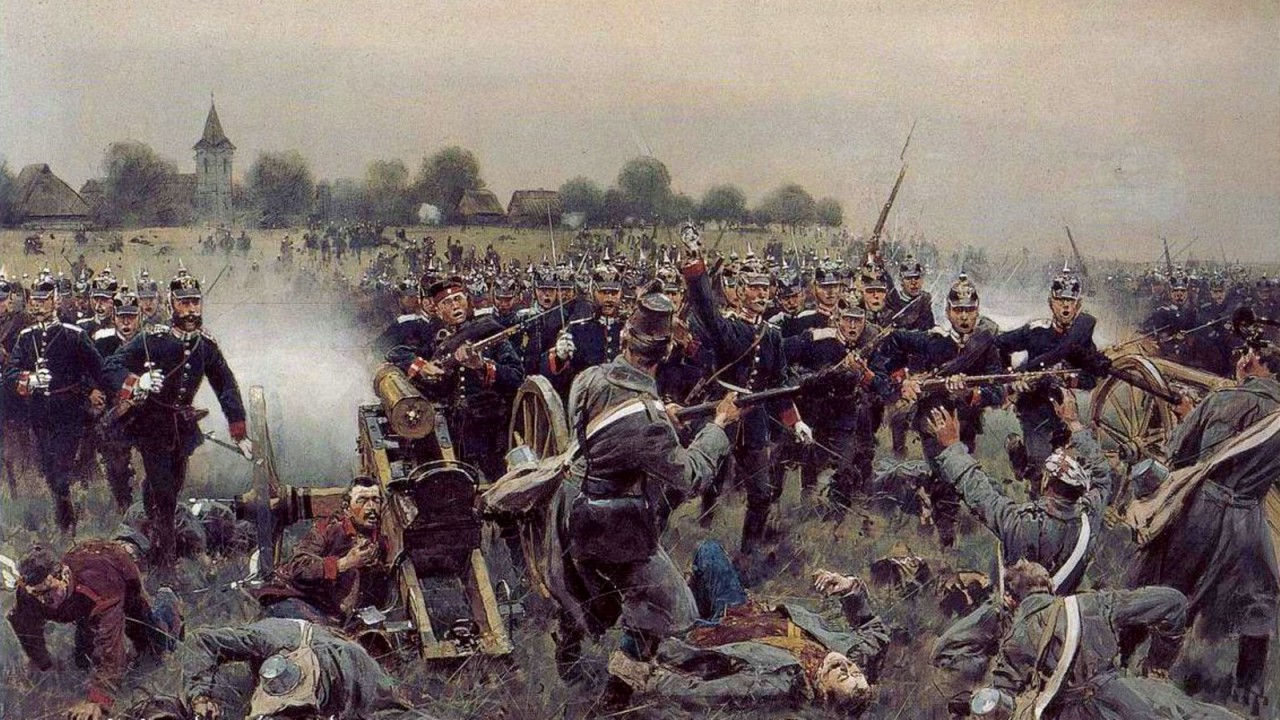
| Austrian infantry, advancing confidently. |
Last weekend I got the opportunity to participate in a test of a new presentation of the battle of Koniggratz that Bruce Weigle will be taking across the ocean to run at a game convention in Germany, to commemorate the 100th anniversary of the battle. The game used the new fast-play version of Bruce's
1866 rules and altered some of the conditions of his published scenario for the battle with the intent of making it a bit more challenging for the Prussian army.
Historically, the Prussian First Army attacked the Austrian Northern Army, which held a strong defensive position on the commanding heights above the town of Sadowa, west of Koniggratz. Prussian troops of the II and III Corps, advancing across open ground in the face of highly skilled and well equipped Austrian artillery batteries, took heavy losses. Only by drawing other Austrian troops piecemeal into a woods battle in the Swiepwald were Prussian forces of the IV Corps able to bleed FZM Benedek's forces enough that by the time the Prussian Second Army arrived to the north of the Austrians was it able to deal a crushing blow to the Kaiserlich und Koniglich forces.
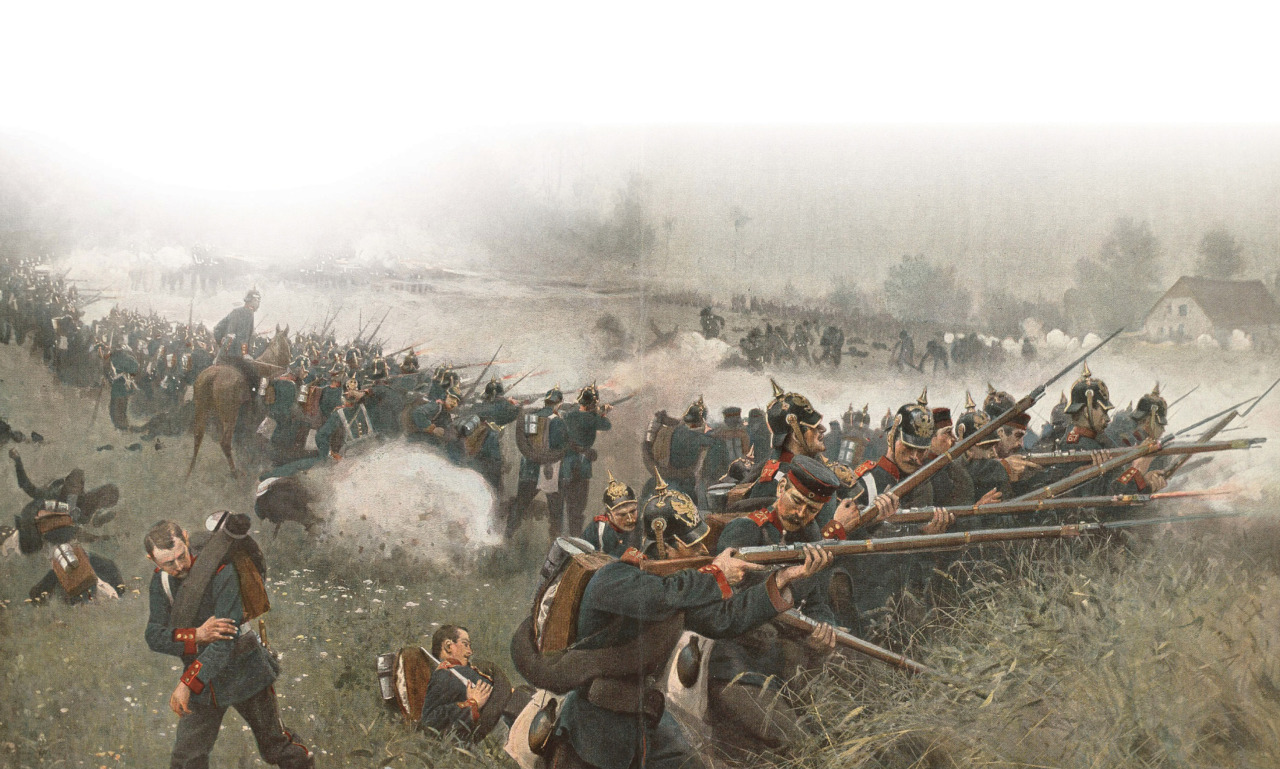 |
| Prussian line infantry blazing away at Koniggratz. |
Bruce had modified the scenario to slow the arrival of the life-saving Second Army (historically, the Prussians on the field before that force arrived were on the ropes and the Austrians were considering a counterattack that could have smashed the Prussian's hopes for a conclusive victory). But most importantly, he gave the Austrians much more leeway in how to employ their forces, keeping them from being bled to death by a battle of attrition in the north and center and allowing them to pull troops from their southern reserves to repel the IV Corps and Second Army attacks.
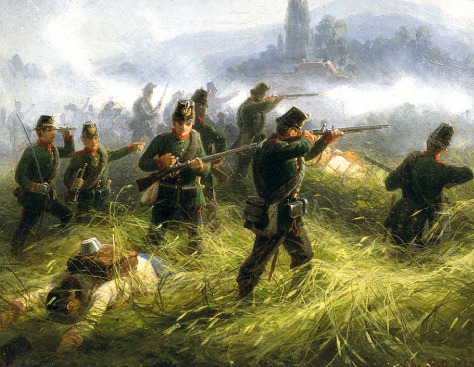 |
| Prussian jaegers also letting the Austrians have what for. |
So in our game, the Prussian Guard and VI Corps, instead of driving through already worn-out Austrian forces like a hailstorm through a field of hay, ran headlong into a solid wall of Austrian troops, many of them holding entrenchments. Meanwhile the Austrian army's reserve artillery had created such a gun line along the plateau to the south that the Prussian II and III Corps, after clearing the forward line of towns on the Bistritz River, had been unable to concentrate their own guns to provide cover for an attack and simply sat and watched the Austrian left and center.
As commander of the Prussian III Corps, I was frustrated at my inability to help our northern forces by putting more pressure on the Austrians. As a player, I enjoyed the game a good deal. I like Bruce's
whole suite of 19th century rules very much, and while I like the greater complexity of the slow-play original rules, I appreciate how hard it would be to stage the replay of a battle of this size without simplifying the game mechanics.
 |
| Prussians overrunning an Austrian battery. Wish I could have done this! |
Following the game, there has been some serious discussion of the scenario among the players and the umpire, and I'm sure that Mr W has fine-tuned the conditions of the engagement so that the end result when run next will be neither the sure thing the Austrians found it to be nor the devastating victory the Prussians historically had, but something much closer to a knife-edge battle, where the players will be able to determine the outcome through their skill (and the luck of the dice).
Although Bruce protested that the game boards were still unfinished, I found them to quite live up to the high standards set by all his amazing creations of the past.
Here are some photos I took during the game.
 |
| Here it's all over for Austria as the Prussians sweep through. |
His work is so admired that many wargamers have posted photos of it on the Web.
There's a page here with some photos giving you an idea how amazing his terrain boards are in closeup and also linking to a PDF of an article on how he builds his boards.
Roundwood's World provides here (at the bottom of the post) some photos of Bruce's Rossbrunn game presented at Colours in the UK in 2013. Here are
more photos I took at a game at Cold Wars in 2012; I think it was the 1866 battle of Burkersdorf. And Operation: Wargaming
posted some pictures here of a winter Franco-Prussian scenario put on by Bruce at last year's Historicon.
Most amazing of all, though, is to think that (after finishing them to his satisfaction), Mr Weigle packed them all up and is winging his way across the Atlantic even as I write to put on this game in Germany! Safe travels, Mr W, to you and your troops and tables!