So, on the 18th of June itself, I have little time, sadly, to blog. I hope that tomorrow I may be able to provide something more of interest relating to the last great battle of the Napoleonic Wars.
Instead, let me point you to a couple of other sites that have interesting posts on Waterloo.
One of these I've linked to in my other Waterloo posts: JJ's Wargames.
Today, instead of providing the sort of detailed summary of the day's events he has done other days this week, he goes on a personal excursus, explaining how he came to be interested in Napeoleonic history. This caused him to travel, not only to Belgium, but to the Iberian battlefields of the Peninsular campaigns. He provides some photos and some telling insights about the ways that Wellington's journeyman battles as army commander led to his masterwork at Waterloo.
The Two Nerdy History Girls blog is another I enjoy, and today they have a piece on the Waterloo experience of Colonel Frederick Ponsonby. Those who have seen Bondarchuk's classic film about the battle, which features a scene of Col. Ponsonby leading the charge of the Union Brigade, may be surprised by the ending of his story.
Earlier in the week, the Girls also posted on the rather horrific aftermath of the battle, featuring JMW Turner's 181 painting The Field of Waterloo.
Historynet had quite a fascinating article several years ago on the women who took part in, or were at least involved in, the battle.
Which I came across when trying to rediscover a link to this article, a piece by the Smithsonian on a prominent American who took a leading role in the British Army's contingent on the field.
What round-up would be complete without links to the 200th anniversary renactment (which promises live streaming video of the event--though it appears one needs to pay a fee for it)
And, perhaps more useful, the (UK) National Army Museum's Waterloo 200 site. (The website for Les Invalides, strangely enough, doesn't even mention this week's events. Their calendar for this week has only an event about Churchill and De Gaulle. Their permanent collection features Napoleonic material in its page on the Modern Department and, of course, the Emperor's tomb, but that's all.)
And I'll close with a link for further reading, if you'd like some: the napoleon-series.org page on Waterloo, with a variety of different articles, including orders of battle, analyses, accounts of singluar incidents, and a transcription of a letter about the battle by no less than Michel Ney.
Showing posts with label Hundred Days. Show all posts
Showing posts with label Hundred Days. Show all posts
Thursday, June 18, 2015

Wednesday, June 17, 2015
Waterloo's 200th: Two Battles and a Retreat
 |
| The games that started it all: SPI's NLB Quad, |
I'd continue to summarize the historic action, but I don't think I could improve on the excellent posts at JJ's Wargames (here are his posts on the initial contacts of the campaign, the first battles, and the Allied retreat).
Instead I'll continue my catalog of the treatments this campaign has received in the wargaming realm. In my last post, I mentioned The Emperor Returns, Kevin Zucker's game on the campaign published by Clash of Arms Games. Of course, the name Kevin Zucker translates into the common tongue as "obsessed with the Napoleonic Wars", so it's no surprise that this was neither his first nor his last game about the Hundred Days.
 |
| Zucker's mini-game of 1815. |
A few years later, Zucker and two other authors created Hundred Days Battles. This 1979 game The Emperor Returns in 1986. I used to have a copy of Hundred Days Battles, though I forget if I played it other than solitaire.
(republished in 1983) was a smaller treatment of the same subject, beginning the use of some of his systems seen in larger form in
In 1998, Zucker came back to Belgium with The Last Days of the Grand Armée. While TER and HDB are both in the 1x (or each turn = one day) family of Zucker's Napoleonic titles, LDGA is in the "Days" series, in which turns are six hours. I've played LDGA only once so far, a learning game with a friend in which the French were ruthlessly pounded. But, playing the Allies, I had the advantage of having played the system before (The Seven Days of 1809), so I don't think this was a representative run-through. Luckily, my friends are intrigued by the series, so I think we'll be playing these and other games in the series again before too long.
 |
| SPI's prequel to WV. |
Zucker is not alone in addressing the battles of the campaign, of course. Of the two great battles of June 16th, Quatre Bras has received more attention, at least in the boardgame world. I count at least eight other Quatre Bras games in addition to that in SPI's quadrigame. Of these I have three: Battles of Waterloo by the prolific and irascible Richard Berg, which includes a Quatre Bras engagement; Ney vs. Wellington, Joseph Balkoski's chip off Frank Davis's Wellington's Victory system, making the smaller battle a good taster for the WV system; and the visually unbeatable La Bataille des Quatre Bras by Ed Wimble.
 |
| A detail of the gorgeous LBdQB. |
But what of the other battle of the day, widely billed as Napoleon's last triumph? Ligny seems to get short shrift compared with Quatre Bras, perhaps reflecting the fascination of English-speakers (long the dominant segment of the wargame design community) with "the English battle" at the crossroads. Though an Anglophile, I've grown fond of the Prussians in the context of the Napoleonic Wars, and I find it sad that while QB gets nearly a dozen titles, Ligny subsists on only four.
 |
| Would Ligny get more games if Wellington had spoken German? |
Tuesday, June 16, 2015
A Brief Interlude: Waterloo's 200th
As I mentioned in an earlier post, June sees a number of exciting (to the military history-minded) anniversaries. I've been exploring the Normandy campaign of 1944, and I'll continue that shortly.
But first we need to take a short detour a century-plus-a-bit back wards. For yesterday (15 June) was the day that the last Grande Armée crossed the French frontier into Belgium, on its way to wreak havoc among the assembled armies of the Kingdoms of Great Britain, the Netherlands, and Prussia. Napoleon I, in a last attempt to restore himself to a stable throne in France, thrust the sword of his army towards the vitals of Allied resistance with one hand while with the other he hopefully waved the olive branch of peace towards his father in law, Kaiser Franz II of Austria. If he could crush the nearest foes and conciliate the next nearest, it might give him time to devise a strategy to deal with the furthest, Czar Aleksandr of Russia. Franz had been willing to side with Bourbon France against his erstwhile allies Aleksandr and Friederich Wilhelm of Prussia; perhaps he could be induced to from a similar alliance with a powerful Bonaparte France...if only the impression of power could be constructed.
Napoleon had an army of some 200,000 men, mostly veterans of his old campaigns, plus another 150,000 forming new units in depots and nearly 200,000 more militia, national guards, marines, and coast guards serving in static positions and freeing up regulars to fight in the field. Would it be enough to defeat his two most implacable foes--the Duke of Wellington, the calm, quick-witted Englishman whom none of his marshals had been able to best, and Prince Bluecher, the mad, wild, fierce old Prussian hussar who had come out of retirement in his Krieblowitz estates to deal a death blow to the hated Corsican.
The Allied armies were distributed in their cantonments across central and eastern Belgium, waiting and watching for the Emperor's blow. It came with the sudden fire of picquets and was followed by the rumble of guns, as the advanced guards of the French army forced back the Prussian outposts on the Sambre. Falling back a short distance from the river, Prussian forces fought a delaying action and then fell back about ten miles, while couriers spurred through the dawn to reach and rouse the Prussian Army and to warn their British and Dutch allies that the enemy was now marching, straight into the strategic "joint" between the two Coalition forces.
While the Prussian advanced troops continued fighting through the day, the first contact between French troops and the forces of the Low Countries did not come until late in the afternoon. At 6 p.m., French light cavalry of General Reille's II Corps attacked and drove in the picquets of a battalion of Nassau infantry some 12 miles from the Sambre on the Brussels road. The remainder of the battalion stood to and, with the help of a battery of artillery, chased off the cavalry scouts. Although Dutch Belgian troops had at first thought that the cannon fore they heard in the distance was Prussian artillery at drill, the gradual nearing of the fire had alerted them that war was almost certainly begun, and to the French cavalry found outposts ready for them, not soldiers slumbering in their billets. The Count de Perponcher Sedlnitsky and Prince Bernhard of Saxe Weimer had already begun moving their troops into position to hold strategic road junctions against the French advance until they should receive more specific orders.
Wellington, in Brussels, had ignored the first reports from the Prussians of French attacks on their outposts. He had likewise ignored the Prince of Orange who, having been on horseback checking his forward lines since 5 a.m., reported at 3 in the afternoon that the Prussians were under attack. Finally, at 4.30, Wellington's Prussian liaison officer passed on a dispatch from Prince Bluecher that Wellington could not ignore. He began issuing alerts to his army, telling commanders to be ready to move once the direction of the French attack was confirmed. But it was not until 10 p.m., when a further message from Bluecher arrived saying that Napoleon himself was leading the French Army across the Sambre at Charleroi, that Wellington finally began to issue orders to his army.
Wargaming
There are, of course, hundreds, possibly thousands of games about the Napoleonic Wars. Boardgamegeek.com lists over fifty on the Waterloo campaign and its climactic battle alone. These range from serious historical studies to simplistic, fast-play treatments to the speculative (Alexander at Waterloo, which pits Wellington's army not against the Old Guard by against the Macedonian Companions), from the sublime (Wellington's Victory: 2,000 counters on a map measured in square feet) to the ridiculous (One Minute Waterloo, with eight pieces on a nine-hex map).
Since I'm going to quickly review the campaign, I'll use an old favourite, Kevin Zucker's The Emperor Returns. I will also be trying to run a semi-double-blind game of this at a local game store next weekend.
The game actually begins just before the French move across the border. The French have the initiative and must decide, as Napoleon did, whether to attack northwest towards Ghent, north towards Brussels, or northeast towards Namur. To drive towards Ghent is, in essence, to attack the Anglo-Allied army's right flank, hoping to defeat the penny packets in which it is spread out over the Belgian countryside and to draw its center of gravity away from its Prussian allies. To drive on Brussels is to attack the "seam" between the two Allied armies--often in warfare the most vulnerable point of two forces, since responsibility for defending the zone where the two meet is often confused and uncertain. To drive on Namur is to attack the Prussians, who are far more concentrated to begin with. This makes them an easier target to find and fix, but also a harder nut to crack. And the wooded, hilly banks of the Sambre will slow down the French attack, giving the British time to get their act together and come to the aid of their Prussian ally.
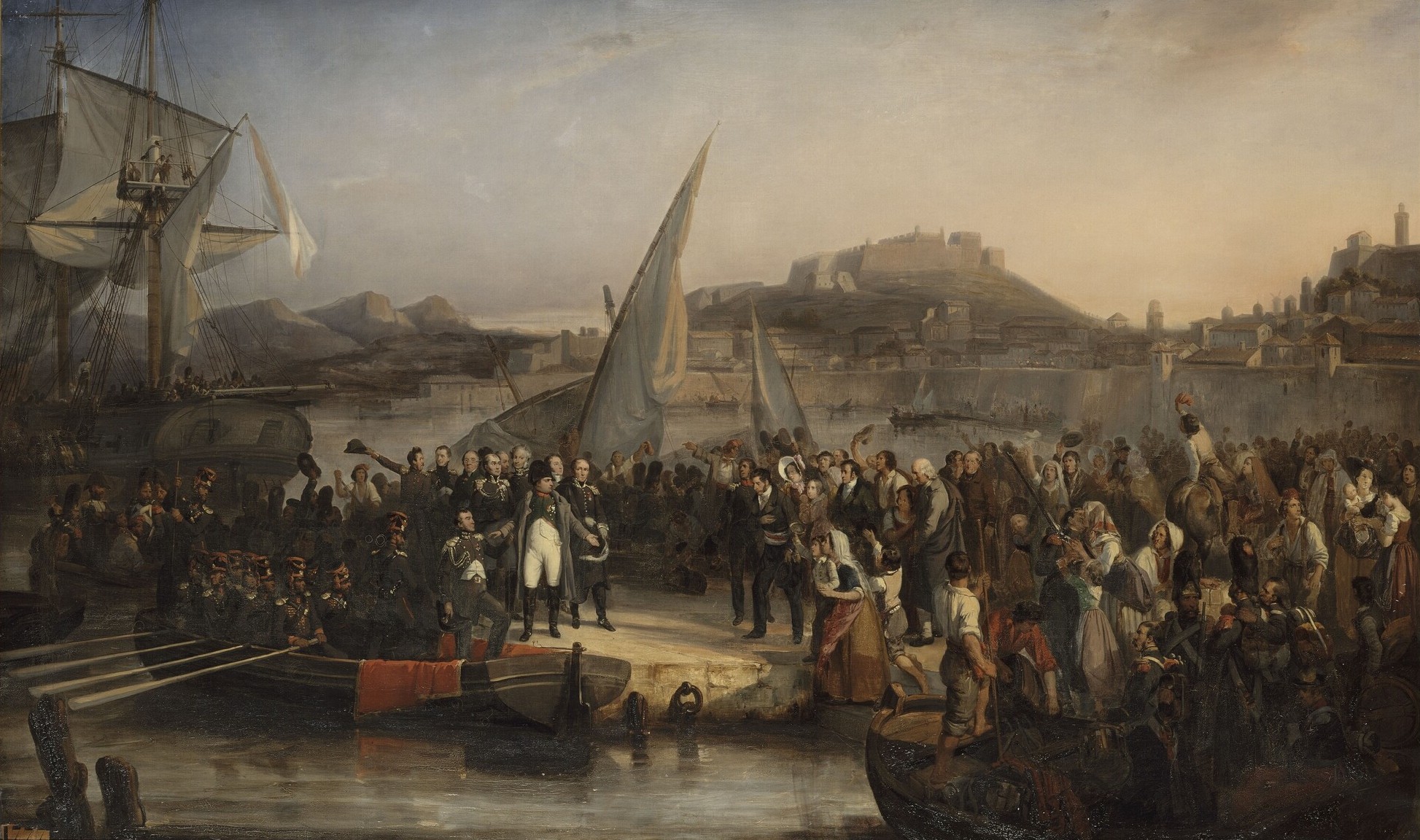 |
| Napoleon Leaving Elba by Joseph Beaume (Wikipedia) |
Napoleon had an army of some 200,000 men, mostly veterans of his old campaigns, plus another 150,000 forming new units in depots and nearly 200,000 more militia, national guards, marines, and coast guards serving in static positions and freeing up regulars to fight in the field. Would it be enough to defeat his two most implacable foes--the Duke of Wellington, the calm, quick-witted Englishman whom none of his marshals had been able to best, and Prince Bluecher, the mad, wild, fierce old Prussian hussar who had come out of retirement in his Krieblowitz estates to deal a death blow to the hated Corsican.
 |
| The positions of major French and Allied Armies on 1 June 1815 (Wikipedia) |
While the Prussian advanced troops continued fighting through the day, the first contact between French troops and the forces of the Low Countries did not come until late in the afternoon. At 6 p.m., French light cavalry of General Reille's II Corps attacked and drove in the picquets of a battalion of Nassau infantry some 12 miles from the Sambre on the Brussels road. The remainder of the battalion stood to and, with the help of a battery of artillery, chased off the cavalry scouts. Although Dutch Belgian troops had at first thought that the cannon fore they heard in the distance was Prussian artillery at drill, the gradual nearing of the fire had alerted them that war was almost certainly begun, and to the French cavalry found outposts ready for them, not soldiers slumbering in their billets. The Count de Perponcher Sedlnitsky and Prince Bernhard of Saxe Weimer had already begun moving their troops into position to hold strategic road junctions against the French advance until they should receive more specific orders.
 |
| The Duke of Wellington by Sir Thomas Lawrence: Confident or over-confident? (Wikipedia) |
Wargaming
There are, of course, hundreds, possibly thousands of games about the Napoleonic Wars. Boardgamegeek.com lists over fifty on the Waterloo campaign and its climactic battle alone. These range from serious historical studies to simplistic, fast-play treatments to the speculative (Alexander at Waterloo, which pits Wellington's army not against the Old Guard by against the Macedonian Companions), from the sublime (Wellington's Victory: 2,000 counters on a map measured in square feet) to the ridiculous (One Minute Waterloo, with eight pieces on a nine-hex map).
Since I'm going to quickly review the campaign, I'll use an old favourite, Kevin Zucker's The Emperor Returns. I will also be trying to run a semi-double-blind game of this at a local game store next weekend.
 |
| The Emperor Returns: Campaign Start Setup (OSG) |
Subscribe to:
Posts (Atom)